
The Chicago Tribune Perplexity AI lawsuit Could Redefine AI Search
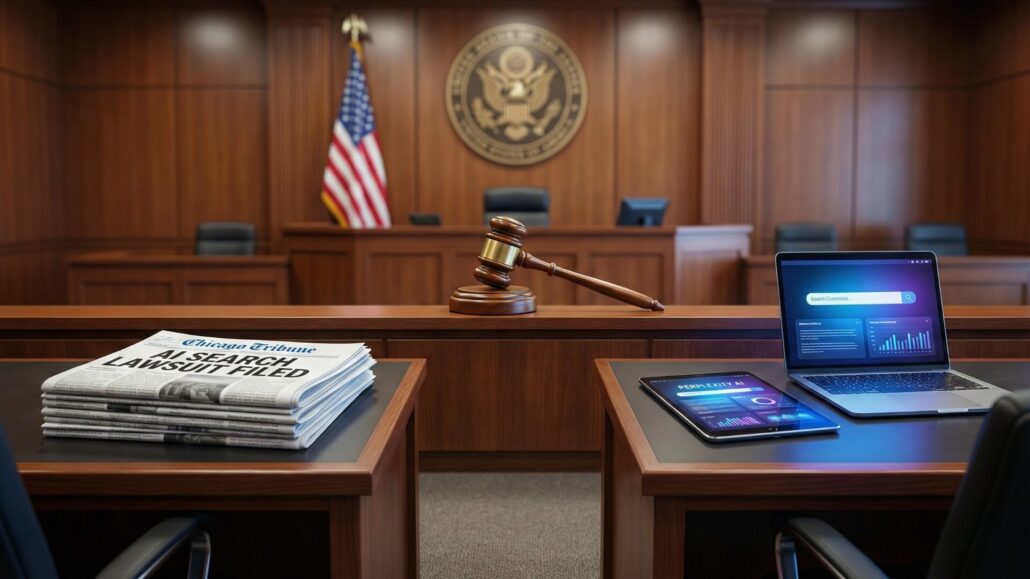
The Chicago Tribune has launched a high-stakes copyright lawsuit against Perplexity AI, and the outcome could shape the future of every AI-powered search tool. At issue is how far AI answer engines can go when summarizing—or reproducing—journalism. As publishers fight to protect their revenue and relevance, this case signals the beginning of a much larger battle.
Why the Chicago Tribune Perplexity AI Lawsuit Matters
On December 4, the Tribune filed suit accusing Perplexity AI of using its reporting—sometimes nearly verbatim, even behind paywalls—in the company’s fast-growing AI answer engine. Unlike older lawsuits focused primarily on training data, the Tribune targets something more current and commercially impactful: real-time AI output.
Perplexity’s system relies heavily on retrieval-augmented generation (RAG), a method that pulls in live or recently scraped information to craft polished answers for users. According to the lawsuit, those answers occasionally mirror the Tribune’s own reporting so closely that users no longer need to visit the paper’s site.
If true, the implications extend well beyond one publication. This is about whether AI engines can effectively become replacement destinations for news.
How RAG Became the Center of the Chicago Tribune Perplexity AI Lawsuit
RAG is the backbone of many modern AI search tools. Instead of generating answers solely from internal model memory, the system fetches information from outside sources—sometimes including paywalled journalism.
The Chicago Tribune Perplexity AI lawsuit argues that this approach results in:
- reconstructed paragraphs that resemble Tribune stories
- deprioritized traffic to the Tribune’s own site
- economic harm tied to lost visibility, lost ad impressions, and lost subscription conversions
If courts determine that RAG-based output qualifies as republishing, it could mean that AI companies must negotiate mandatory licensing agreements with news organizations. This would represent the most significant shift in search economics since Google News changed how headlines circulate online.
More Publishers Join the Fight
The Tribune is not alone. Several major outlets—including The New York Times, Dow Jones, and Britannica—have raised similar allegations in separate suits or public statements. The Times specifically claims Perplexity reproduced “verbatim or near-verbatim” outputs of its work.
This wave of coordinated legal action signals a turning point: publishers are no longer waiting for AI companies to build business models that include them. They’re demanding it through litigation.
What This Could Mean for AI Search
A ruling in favor of the Tribune could force major changes across the AI industry:
- Structured licensing for news content, similar to music-streaming royalties.
- RAG redesigns to reduce copyright risk.
- Stricter auditing of sources used in answer engines.
- Greater transparency about how AI retrieves and displays information.
On the other hand, if Perplexity prevails, it strengthens the argument that publicly accessible web content—even when paywalled—can be ingested and re-expressed algorithmically.
Either outcome will carry long-term consequences for both journalism and technology companies.
The Bigger Question: Who Owns the Answer?
At its core, the Chicago Tribune Perplexity AI lawsuit asks a deceptively simple question: when an AI engine produces a highly detailed answer that eliminates the need to click on a news article, who owns that moment of value?
Journalism, historically, has been funded by attention—traffic, ads, subscriptions, and visibility. But AI collapses all of that into a single text box. It gives readers the essential information but strips away the surrounding business model.
As AI becomes the primary way many users interact with information, this lawsuit may be the first major test of whether the law can adapt.
Wrapping up
The Chicago Tribune Perplexity AI lawsuit isn’t simply a copyright disagreement. It’s a fundamental clash over how knowledge is gathered, packaged, and monetized in the age of AI search. Whether courts side with the Tribune or with Perplexity, the decision will shape the next decade of journalism, technology, and digital information access.
If this battle defines who controls the answers, the ripple effects will be felt everywhere—from newsrooms to AI labs to the everyday user asking a simple question.





Leave a Reply
Want to join the discussion?Feel free to contribute!