
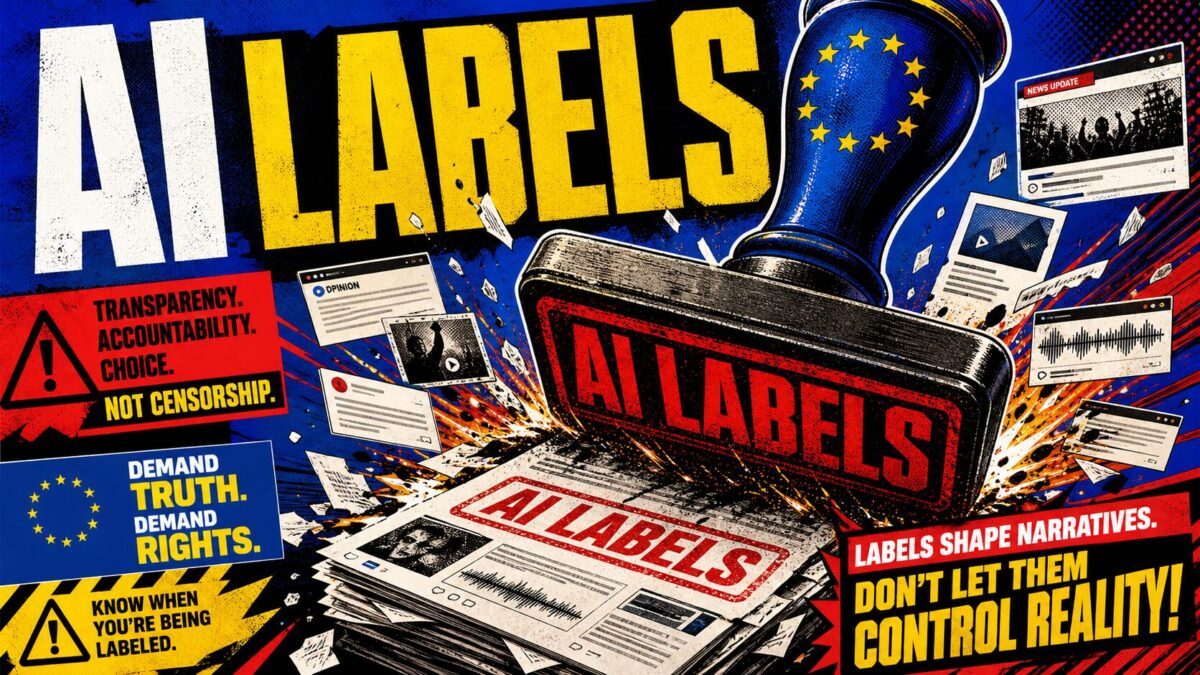
EU AI labels enforcement begins in the European Union on August 2. The Guardian reports that starting Sunday, the EU requires companies to mark content that was generated by AI when it’s designed to look authentic. Images, audio, and text all count, and so does most commercial use. This is the enforcement phase of the AI Act, the EU’s landmark AI regulation. The rules apply to new AI systems put on the EU market. Systems that were already out there get four extra months to comply.
Sergey Lagodinsky, the EU parliament member who helped negotiate the act, said “It is a matter not only of customer protection, it’s also a matter of democracy protection.”
That framing is doing a lot of work, but the core point holds. EU AI labels are about telling people when they’re looking at something that never happened.
What the EU AI labels actually require
The mandate covers generated images, audio, and text that are intended to look real. The EU created its own black-and-white labels that any organization can use, but companies are also free to design their own. The key word is authenticity. A cartoon cat with six ears doesn’t need a label. A photo-realistic image of a politician that was generated by a model does.
Personal content is exempt, so your group chat still works the way it always did. There’s also an exemption for evidently artistic, satirical, and fictional works, which is how deepfakes of celebrities for comedy sketches stay legal. The line between satire and deception is going to be a fun one to litigate.
Where the EU AI labels will show up
The surprising part, according to an AI policy lead at the Computer and Communications Industry Association, is that consumers may not expect where these labels appear. Most AI-generated content on social media already carries some form of labeling. The shock will come in areas where AI is already used at scale without most people noticing: advertising, film, and publishing.
That tracks with what I’ve seen this year. TikTok requires creators to label AI content, yet the platform keeps surfacing AI-generated doctors giving dubious health advice. The Guardian reported on those videos. Policy only works when enforcement actually reaches the feeds where the fakes live.
The tools for doing this already exist. Google’s SynthID system watermarks images to identify them as AI-generated, and it now offers a detection tool. Meta’s labeling policy covers photo-realistic images on Facebook, Instagram, and Threads. The infrastructure is there. The question was whether it would be legally required, and now it’s law.
Why EU AI labels are only a start
I want to be honest about the limits here, because this week handed us a perfect demonstration. Google launched an AI image generator inside Google Earth on Thursday, and a researcher immediately used it to create fake satellite imagery of a nuclear plant in Iran and a bomb crater in Gaza. The images were watermarked as AI generated. As TechCrunch reported, the researcher still showed he could fool an AI detection tool with a video made in the same feature.
Watermarks and labels are a start, not a cure. Anyone can screenshot a labeled image, crop the label, and re-share it. Detection tools get better, but so do generators. What the EU is doing is still worth doing, because it pushes the cost of honesty onto the companies making the content and gives platforms a legal hook to enforce against.
AI law has been moving fast all summer. The German court ruling on Suno showed that courts are starting to grapple with what AI can and can’t use. The new AI chip export restrictions from Washington are part of the same squeeze. The label mandate is the same story on the distribution side. The EU is deciding that consumers deserve to know when a machine made what they’re looking at.
Here’s the thing that matters most. The August 2 deadline applies to new AI systems on the EU market. For the rest of us, EU AI labels are about to become a normal part of the internet, right alongside terms of service and cookie banners. They won’t stop every fake. They will make the fakes easier to spot, and that’s a real improvement.


