
AI News
Murf Falcon 2 Undercuts ElevenLabs at 1 Cent a Minute
Murf AI's Murf Falcon 2 voice model is public at one cent per minute, a fifth of ElevenLabs pricing, with sub-100ms latency and enterprise voice cloning for real-time voice agents.
 By Tony Simons 4 min read
Disclosure: We may earn a commission when you shop through the links below. It never changes the verdict. Details

Disclosure
We may earn a commission when you shop through the links below. Opinions stay independent. Full disclosure
Murf AI just turned the AI voice price war into a street fight with the Murf Falcon 2 launch.
The company’s new Falcon 2 voice model went public on August 20, 2026, and it sells synthetic speech for one cent per minute. That’s roughly a fifth of what ElevenLabs charges for the Turbo and Flash models that most voice agents run on today.
If you build anything that talks in real time, this is the Murf Falcon 2 launch to read closely. Murf isn’t a weekend project either. The Next Web reports that the Bangalore company was founded in 2020 by three IIT Kharagpur engineers, claims around 10 million users, and serves 300 corporate customers including Cisco and Pfizer.
The Falcon 2 price math that matters
The pricing is the whole story here. Falcon 2 costs one cent per generated minute, and Murf keeps the rate flat with no tiered games.
At volume the gap compounds fast, because a million minutes of speech costs about $10,000 on the new model against roughly $50,000 on ElevenLabs Turbo and Flash.
That price lands while OpenAI keeps cutting prices across its model lineup, and the broader trend is unmistakable: every corner of generative AI is racing the same direction. Compute gets cheaper, and per-minute prices follow it down.
What Murf Falcon 2 actually delivers
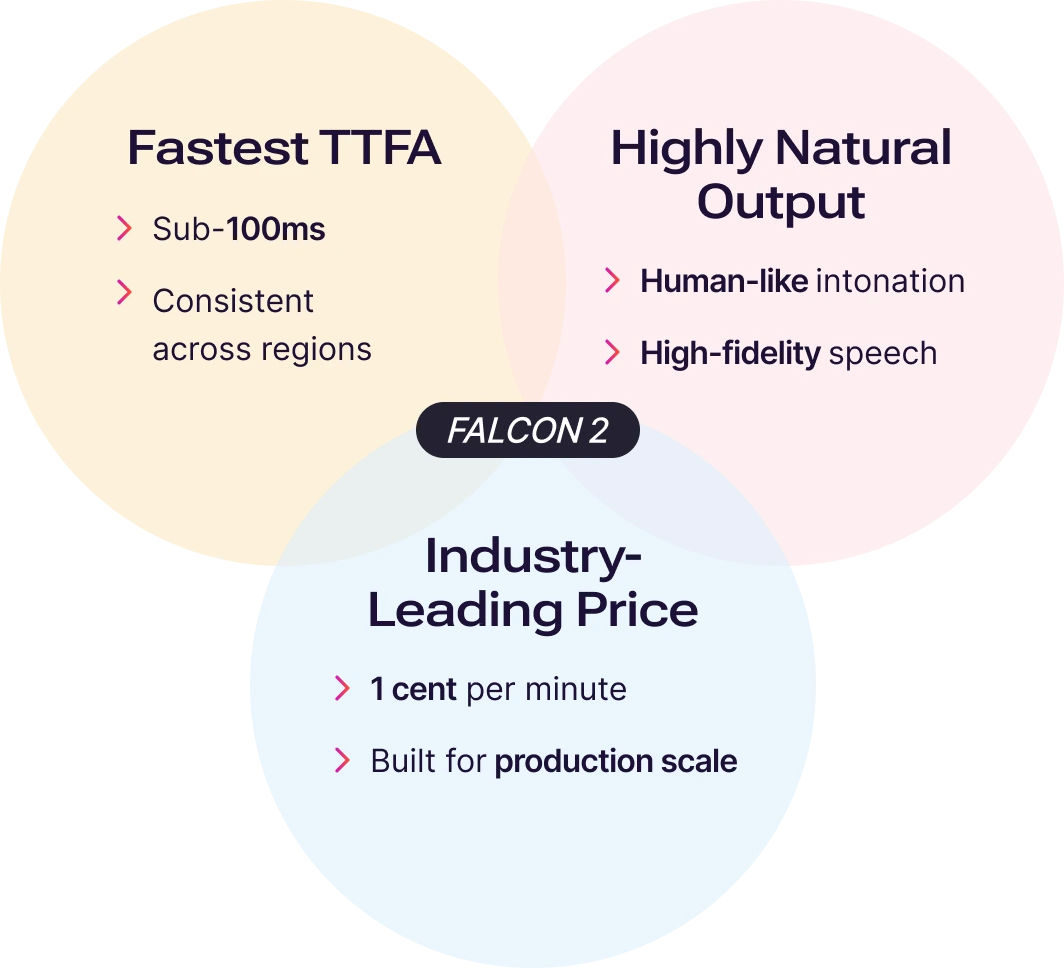
Murf is not only selling a price, it is selling latency. The company says that in blind listening tests the new model was preferred 10x more often than the previous Falcon, and it cut time-to-first-audio below 100ms.
The latency number matters more than it sounds. Real-time voice agents feel broken above a couple hundred milliseconds of delay, so a benchmark run through apiping.io with more than 1,500 pings from multiple global locations, where the model ranked first in every region, is the kind of claim a builder can actually test in an afternoon.
There’s more under the hood. The model ships with 150+ voices across 35+ languages, handles code-mixed text like Hindi threaded through English, and was trained on real customer calls and booking conversations rather than scripted narration. Murf also added instant voice cloning for enterprises that need less than a minute of reference audio.
The official page demos four finished conversations: appointment booking, collections, lead qualification, and customer support, including Indian English with Hindi code-mixing. Those are exactly the workloads where cheap per-minute speech changes unit economics.
One caveat on the price. The one-cent rate is for generated speech through the API, and enterprise features like custom cloning, on-prem deployment, and data residency are negotiated with sales. Murf sells the developer API at $0.01 per minute with no confusing tiers, even as the rest of the catalog routes enterprise buyers to Contact Sales.
Why the Falcon 2 claims need a test drive
Some of this deserves patience. The leaderboard claim comes from Murf itself, pointing at Artificial Analysis scores above some OpenAI entries, including the Realtime API, and nobody outside the company has stress-tested the model yet.
Murf made a similar splash with the first Falcon in November 2025 and a press release about 55 millisecond latency.
The enterprise plumbing looks real regardless. Falcon 2 supports up to 10,000 concurrent calls, data residency in 11 geographies, and on-premise deployment for teams that need full control over where voice data lands.
For anyone who has priced a voice agent this year, the difference isn’t subtle. A deployment handling a million minutes a month was a five-figure line item on incumbent pricing, and it’s now within reach of a seed-stage team.
What the Falcon 2 launch means for builders
The competitive context is what makes this fun. ElevenLabs is reportedly in talks at a $22bn valuation. Poland has taken an $11 million stake in the company, and the UK government signed an agreement to use its voice AI in public services.
Europe’s flagship voice company has been selling quality and trust while assuming price would follow. The Murf Falcon 2 challenger claiming comparable benchmarks at a fifth of the cost is the first real stress test of that order.
My honest take: if you already pay ElevenLabs rates, benchmark the new model against your own prompts this week, because a fifth of the cost is a fifth of the cost.
If you’re starting a voice agent from scratch, the one-cent floor changes what’s viable at all. I have been tracking this pricing collapse all year, from the AI track that climbed the charts to the model-by-model price cuts, and voice was the last expensive corner left.
Watch what happens next rather than taking any press page at face value. If ElevenLabs responds with a price cut of its own, the whole market reprices overnight.
If the independent numbers hold up under third-party testing, quality stops being a moat. Either way, the voice agent stack just got its first genuine price fight, and the Murf Falcon 2 launch is the match that lit it.
Reviewed & written by
Tony Simons
Tony has a bachelor's degree from the University of Phoenix and over 14 years of writing experience between multiple publications in the tech, photography, lifestyle, and deal industries.