
The AI Art Panic Is Just History Repeating Itself
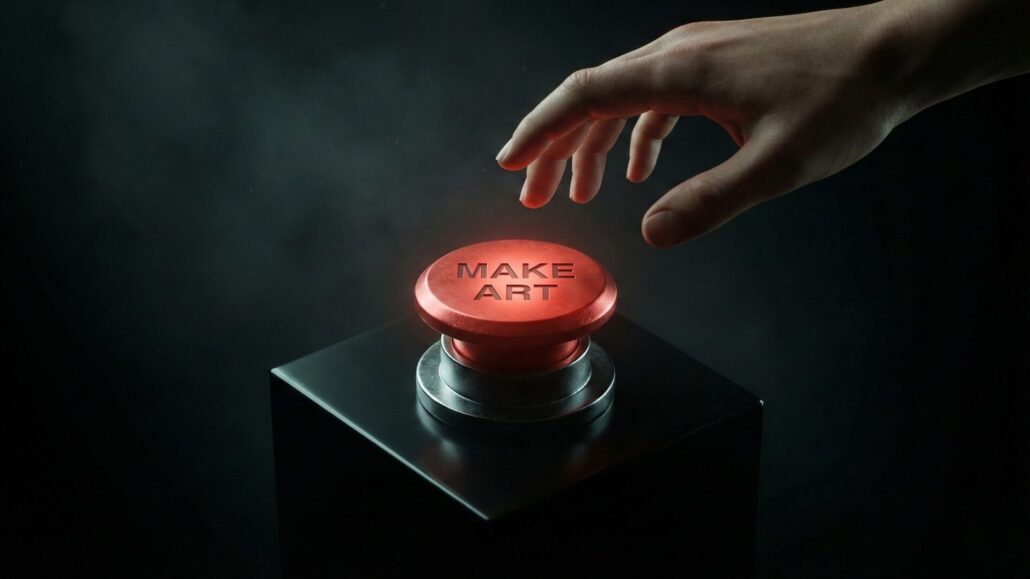
“This industry, by invading the territories of art, has become the most mortal enemy of art. It is the refuge of every would-be painter, every painter too ill-endowed or too lazy to complete his studies. If it is allowed to supplement the functions of art, it will soon supplant or corrupt them all.”
It sounds exactly like a tweet you might have read this morning about ChatGPT‘s image generator or Nano Banana Pro. It encapsulates the current mood perfectly: the anger at a machine doing human work, the disdain for the “lazy” people using it, and the existential fear that “real” creativity is dying.
But that quote isn’t about AI. It was written in 1859 by the poet and critic Charles Baudelaire. And he wasn’t talking about a computer; he was talking about the camera.
In the mid-19th century, the established art world looked at photography with the same visceral disgust we currently see directed at generative AI. They argued that because the machine did the heavy lifting—capturing the light, rendering the perspective, freezing the moment—the human operator was nothing more than a technician. A button pusher. A cheater.
They were wrong then, and the critics shouting that “AI isn’t real art” are wrong now.
We are currently living through a massive historical rhyme. The tools have changed, shifting from chemical plates to diffusion models, but the panic is identical. And just like photography eventually moved from a scientific curiosity to a respected art form hanging in the Louvre, AI generation is destined to do the same. The only difference is that this time, the transition is happening at the speed of software.
The “Button Pusher” Fallacy
The most common insult thrown at AI artists is that they are “prompt monkeys.” You type a few words, hit enter, and the machine does the rest. Therefore, the argument goes, there is no skill, and thus no art.
This is the “Button Pusher” fallacy, and if we accept it, we have to throw out half of modern art history.
Consider the street photographer. They walk down a busy avenue. They see a moment—a shadow hitting a wall, a couple kissing—and they press a shutter button. The physical effort required to take that photo is negligible. A child could press the button. Does that mean Henri Cartier-Bresson wasn’t an artist? Of course not.
The art of photography isn’t in the chemical development; it is in the selection. It is in the curation. It is in the artist’s eye deciding what is the image and what isn’t.
AI art is the ultimate evolution of this principle. When a creator works with AI, they act less like a painter and more like a Director. They provide the vision, the mood, and the blocking. They might generate 500 variations, tweak the prompt 50 times, and spend hours in Photoshop compositing the hands that the AI inevitably messed up.
Marcel Duchamp proved this over a century ago with Fountain. He didn’t mold the porcelain urinal; he bought it. But by choosing it, signing it, and recontextualizing it, he made it art. He shifted the definition of art from “manual craft” to “intellectual intent.” AI is simply the latest tool for that intent.
It’s Not a Collage Machine
One of the reasons the “It’s not art” argument sticks is that people fundamentally misunderstand how the technology works. A persistent myth is that AI generators are just high-speed collage tools, “photobashing” bits of existing images together from a database.
If that were true, the critics would have a point. But it isn’t.
AI image generators use a process called Diffusion. They don’t store images; they store concepts. During training, the model learns what “a sunset” looks like by analyzing the mathematical relationships between pixels. It learns the statistical probability of an orange pixel being next to a yellow pixel in that context.
When you ask for a “cyberpunk detective,” the AI isn’t cutting and pasting a detective from a movie poster. It is starting with a canvas of pure static (random noise) and hallucinating a pattern out of it, pixel by pixel, guided by your text.
It is arguably more similar to how a human dreams than how a computer copies. When you dream of a face, your brain isn’t “copy-pasting” a photo of your mother; it is reconstructing the concept of her face from memory. That is what the AI is doing. It is creating something mathematically new.
The Elephant in the Server Room
We cannot defend the medium without acknowledging the valid anger of the community. While the output is art, the input is an ethical nightmare.
Companies scraped billions of images from the open web—including copyrighted artwork—to train these models without consent or compensation. This is the original sin of the AI boom. Artists are right to be furious that their life’s work was vacuumed up to train a machine that can now mimic their style in seconds.
However, we must separate the tool from the corporation.
We can believe that artists deserve a vehement defense of their copyright and an “opt-out” mechanism, while simultaneously acknowledging that the resulting images are a valid form of expression. We can love the camera while hating Kodak’s business practices.
The legal system is already grinding into gear to solve this. The U.S. Copyright Office has currently taken the stance that purely AI-generated works cannot be copyrighted, requiring “substantial human authorship” to qualify. This is a healthy guardrail. It forces “AI Artists” to actually be artists—to paint over, edit, composite, and transform the raw generation into something that is undeniably theirs.
The Camera for the Imagination
History tells us how this story ends.
In 1859, Baudelaire feared photography would corrupt art. Instead, it liberated it. Because photography became the master of realism, painters were freed from the burden of documenting reality. They stopped trying to be photorealistic and started inventing Impressionism, Cubism, and Surrealism. Photography didn’t kill painting; it forced painting to evolve.
AI will do the same. It is a camera for the imagination. It lowers the barrier to entry, allowing people with vivid dreams but poor manual dexterity to finally show the world what is in their heads.
In twenty years, we won’t be arguing about whether “AI Art” is real art. We won’t even call it “AI Art.” We’ll just call it art. And the critics will have moved on to complaining about whatever comes next.
What do you think about AI art? I’d love to hear your take in the comments.






Leave a Reply
Want to join the discussion?Feel free to contribute!