

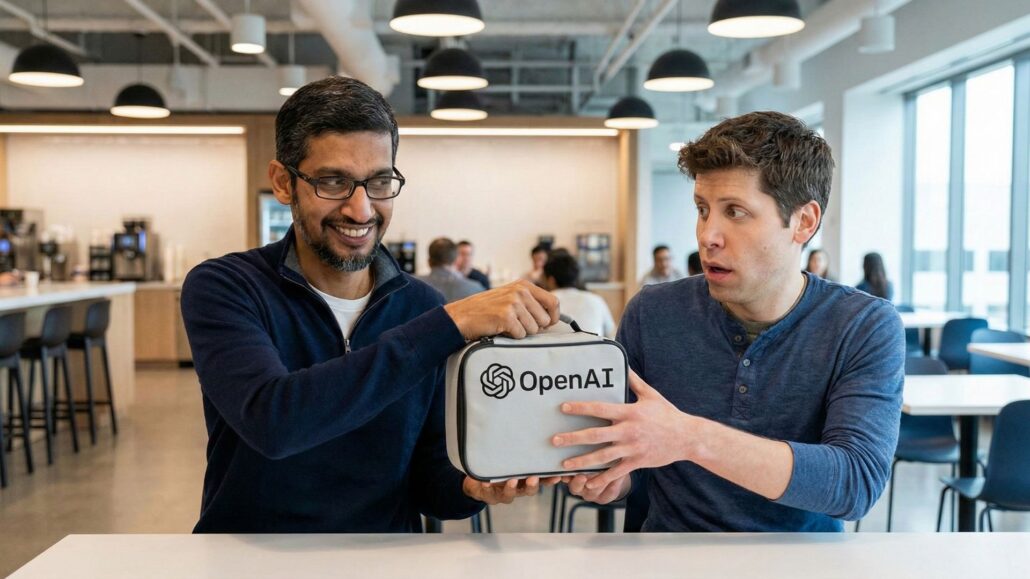
If you had asked me two years ago who would ultimately win the AI arms race, I would have bet the farm on Sam Altman. If you asked me last year, I would have told you it was a coin toss, mostly because Google still seemed trapped in its own bureaucracy.
But after the absolute clinic Google put on in the fourth quarter of 2025, the debate is effectively over.
While OpenAI spent the back half of this year scrambling to ship a lackluster GPT-5.2—a release that felt more like a panic button than a product launch—amidst internal “code reds” and yet another wave of safety team exoduses, Google wasn’t just shipping products. They were systematically building an inescapable ecosystem, brick by brick. From the sheer reasoning dominance of Gemini 3 to the oddly-named-but-incredible Nano Banana Pro, Google didn’t just catch up in 2025. They lapped the competition.
It no longer feels like Google is chasing OpenAI. It feels like OpenAI is actively choking on Google’s dust. Here is why Mountain View is winning right now, and why 2026 looks even worse for ChatGPT.
The “Nano Banana” Is No Joke
Let’s address the elephant, or rather, the fruit, in the room. When Google announced Nano Banana Pro in November, my timeline had a field day with the name. It sounded like a desperate attempt to be “gen z” or viral. A year ago, branding that silly would have been the death knell for a product trying to be taken seriously.
But then I used it, and the laughing stopped immediately.
Powered by the Gemini 3 Pro Image model, Nano Banana Pro isn’t just “better” than DALL-E 3 in the way a slightly faster car is better. It operates in a different reality entirely. It handles text rendering perfectly (finally banishing the days of garbled alien gibberish on generated signs) and understands complex spatial reasoning in prompts that would make other models choke. If I ask for a “cyberpunk coffee shop with a neon sign reading ‘Open’ in the top left window and a cat sleeping on the bottom right sill,” it nails the placement (almost) every single time.
Most importantly, it is integrated directly into the Workspace tools I actually use. I don’t have to tab out to a discord server or a separate web app. I’m in Google Slides, I type what I need, and it appears on the slide, layered and ready to edit.
While OpenAI was busy trying to make Sora accessible to the masses (and arguably failing to scale it efficiently due to those massive compute costs), Google quietly made high-fidelity image and video generation a native feature in Slides and Vids. The “Banana” might sound goofy, but the utility is deadly serious.
Gemini 3 vs. GPT-5.2: The Gap Widens
The release of Gemini 3 in November was the turning point. For the first time, a Google model didn’t just match GPT-4o or GPT-5 on benchmarks; it crushed them in “vibe checks,” which is the only metric that actually matters to daily users. Benchmarks are for researchers; “does it annoy me?” is the metric for the rest of us.
- Reasoning: The new “Deep Think” capabilities in Gemini 3 Pro consistently outperform GPT-5.2 in complex logic and coding tasks. I threw a complex Python refactor at both models yesterday—a messy script with legacy dependencies. Gemini one-shot the solution, explaining why it chose specific libraries. ChatGPT, meanwhile, hallucinated a library that hasn’t existed since 2023 and got stuck in a loop trying to fix its own error.
- Multimodality: Gemini was built multimodal from the ground up, and you can feel it. GPT-5.2 still feels like a brain stitched together from different organs (vision, voice, text) that don’t always talk to each other. Gemini sees, hears, and speaks fluently without the lag or the awkward handoffs between models.
- Speed: Gemini 3 Flash is arguably the most impressive piece of engineering of the year. It is frighteningly fast and cheap, making it the default choice for developers who previously lived on the OpenAI API. When you can get GPT-4 level intelligence for pennies and near-instant latency, the choice becomes obvious.
Antigravity and the Open Source Victory Lap
If Gemini is the brain, Google Antigravity is the nervous system.
Released alongside Gemini 3, Antigravity is the “agentic” IDE that GitHub Copilot Workspace wanted to be. By moving from a text-editor-first approach to an agent-first approach, Google has fundamentally changed how we write code. I’ve been using it to refactor Python scripts for my own tools, and it doesn’t just autocomplete lines; it plans entire implementation strategies and tests its own work. It feels less like a tool and more like a senior engineer pair-programming with me, catching bugs before I even hit ‘run.’
But the real flex here is Gemma 3. While OpenAI remains a closed garden, guarding its weights like state secrets, Google released Gemma 3 back in March and effectively killed Llama 4 for local development. Running a 27B parameter model this smart locally on my laptop, without sending data to the cloud, is something Sam Altman simply cannot offer me. For privacy-focused devs, the conversation ends there.
The “Ecosystem” Is The Real Moat
This is where the lunch-eating really happens. In 2025, Google stopped trying to force me to visit a destination (gemini.google.com) and started putting the AI where I actually work and live. They stopped building “AI features” and started building an AI layer that sits on top of everything.
- Project Astra: We saw the demo way back in 2024, but the full rollout in Android 16 is the “killer app” we were promised. Pointing my phone at a broken bike chain and having Gemini walk me through the repair step-by-step (with visual overlays anchored to the real world) felt like living in the future. Siri still can’t even tell me if it’s raining without a delay or referring me to a web search.
- Google Vids: Remember when this was just a demo? Now that it’s fully live in Workspace, creating storyboards for my video reviews has gone from a 4-hour task to a 20-minute review session. It pulls assets from my Drive, understands the script context, and suggests b-roll that actually fits.
- NotebookLM: This became my default research tool this year. The Deep Research agent doesn’t just summarize; it connects dots I didn’t know existed, finding relationships between papers that would have taken me weeks to uncover manually.
The Silver Lining: What OpenAI Got Right
To be fair, OpenAI didn’t completely strike out in 2025. Sora 2, released in late September, is genuinely impressive.
For pure cinematic generation, it still holds a slight edge over Google’s Veo in texture handling and lighting. Plus, the new audio sync feature is magic; hearing the wind rush exactly when the camera pans is a detail that sells the illusion. If you’re a Hollywood filmmaker, you’re probably still using Sora. But for the rest of us just trying to make a presentation or a YouTube short? It’s overkill compared to the seamlessness of Google Vids. Sora 2 is a Ferrari—beautiful, expensive, and high-maintenance. Google Vids is the self-driving Uber that actually gets you to work on time.
The Verdict: 2026 Looks Green
I want to see OpenAI succeed because competition is good for us consumers. Monopolies tend to get lazy, and Google has been guilty of that in the past (see: Google Search, circa 2018-2022). We don’t want a world where one company holds all the cards.
But right now, the momentum is entirely one-sided. Google has the data, they have the compute (those Ironwood TPUs are screaming fast and power-efficient), and finally, they have a coherent product vision.
Unless OpenAI has a miracle waiting in the wings, something significantly bigger than a “5.2” or a “Sora beta,” Google is going to do more than just eat their lunch in 2026. They’re going to buy the whole restaurant, redecorate it, and automate the kitchen before Sam Altman can even order an appetizer.
Thoughts? Drop ’em in the comments. I’d love to hear from you!




You’re right about specialization being key—I’ve seen the same pattern with trading tools. General AI integration sounds great until you’re actually running it through a full market cycle and watching drawdown spike. I spent months chasing generic forex bots before switching to Ratio X Toolbox, which has dedicated gold EAs built specifically for XAUUSD rather than trying to force a one-size-fits-all model. The difference in backtest stability and live performance is night and day when the tool is actually designed for your market. Have you found the same limitation with off-the-shelf solutions in your own trading?