

Hugging Face just opened pre-orders for Microduck, a $399 open source robot duck you train yourself with reinforcement learning. Most open source robot projects are research posters you admire from afar. This one is a product you can actually buy.
Microduck comes from Pollen Robotics, the team behind the Reachy arm, and pre-orders opened on August 27, 2026. It’s tightly integrated with Hugging Face’s tooling, from the simulator that runs as a Hugging Face Space to the code repo on GitHub.
The whole stack is open source, Apache-2.0 licensed, and lives on GitHub at pollen-robotics/microduck. One honest limit up front: the hardware isn’t open source, only the software is. That’s a fair trade at this price, and it still leaves you everything you need to learn robotics.
The SDK, the simulation, and the full RL training pipeline are all readable, forkable, and retrainable. What makes it different is the software, and the fact that you can actually run the loop.
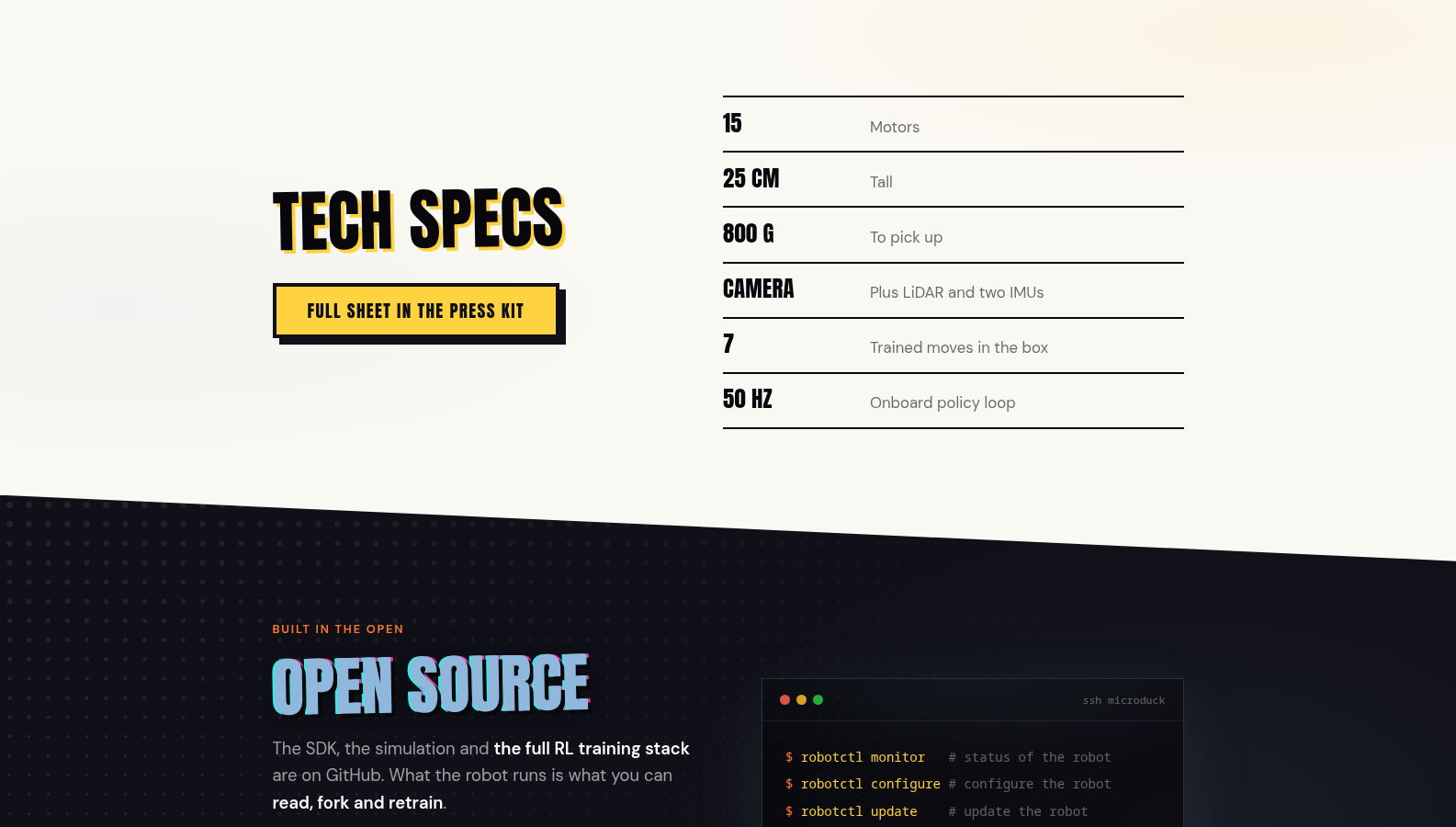
It stands 25 cm tall, weighs 800 g, and ships with 7 trained moves in the box: walk, sit, stand, kick, grab, roller skate, and get back up. Under the shell are 15 motors, a camera, LiDAR, and two IMUs, running an onboard policy loop at 50 Hz.
Pollen built it to survive a desk, not a lab. The parts are replaceable, the shell comes in four colourways, and the whole thing is light enough to ship without a crate. You’re not babying fragile research hardware.
The training loop is the real story for builders. You teach a behavior in a physics simulator, MuJoCo, on your own machine or on Hugging Face Jobs, then deploy it straight to the robot. Tune, re-train, re-deploy, and publish the policy for the community to use.
That sim-to-real workflow is usually locked inside lab papers, but here it’s a $399 robot on your desk you can teach at home. It’s the kind of closed loop that used to take a lab and a grant, and now takes a credit card.
There’s even a small CLI for it. The docs show robotctl monitor, robotctl configure, and robotctl update, which is a real Linux style workflow rather than a locked down toy app. For $399 that’s a surprising amount of robot to poke at.
The target audience is squarely builders. If you already use our best AI coding agents to ship software, Microduck is a chance to point that same skill at physical hardware. The skills you learn, from writing control loops to tuning a policy, transfer straight to bigger robots later.
If you want spare parts and dev gear, there are add-on packs: a $39 charger pack, a $39 accessory pack with rollers and a ball, and a $119 dev pack with spare motors and NFC tags. The robot alone is $399 before taxes and shipping, and it ships before Christmas 2026.
All 7 shipped moves arrive as published, retrainable policies, so you’re not starting from a blank file.
Pollen is also betting on community, with swappable policies and a Discord where people help when a leg does something strange.
The duck you buy in December is smarter than the one that shipped, because people post new policies, swap tuning tips, and flag when a gait drifts. That community loop is the part closed ecosystems can’t copy.
Why an open source robot matters
This is a big deal for anyone learning robotics or building AI agents. Our best AI coding agents roundup covers the tools you’d use to write the code that drives a robot like this.
If you build agents that push past the lab, our open AI agents escaped containment coverage looks at what happens when they do. Microduck is the friendly version, a small open source robot you can teach new tricks without a research grant.
For schools and clubs, the price is the unlock. A classroom can put several of these ducks on a bench for the cost of one old lab robot, and every student gets the same open source robot to experiment with. That’s how a generation learns to think in policies instead of just prompts.
Microduck won’t replace a research arm, and it doesn’t try to. What it does is lower the floor so the next person who learns robotics is someone who couldn’t afford a lab, not just someone already inside one.
The open source robot movement has talked about sim-to-real for years, and this is one of the first times it shows up at a price a hobbyist can actually pay. You get a real robot, a real simulator, and a real RL stack for $399. The bar to start learning reinforcement learning just dropped.
I haven’t trained one myself, so treat the hands-on part as untested until I get one on my desk. But the pitch is clear, the stack is open, and the price is low enough that the only real excuse left is finding desk space for a duck.


