AI & Software · Review
JooVoice Review: I Sent an AI to Make 8 Real Phone Calls. Here’s What Happened
I sent JooVoice on eight real phone calls in five languages. It handled rude clerks and strange requests—but also made an accuracy mistake. Here's my review.
 By Tony Simons 15 min read
Disclosure: We may earn a commission when you shop through the links below. It never changes the verdict. Details

Disclosure
We may earn a commission when you shop through the links below. Opinions stay independent. Full disclosure
Sponsored: JooVoice paid for the accompanying video and provided testing credits. Opinions here are my own.
Jeremy from JooVoice sent an AI named Val to call me. Not to sell me anything. To roast me about my vape.
And it was good enough that, at first, I wasn't entirely convinced I was talking to an AI.
That's how this started. Jeremy followed it up with a gift pass loaded with 69 credits (yes, really), and I figured the only reasonable response was to send JooVoice into the wild.
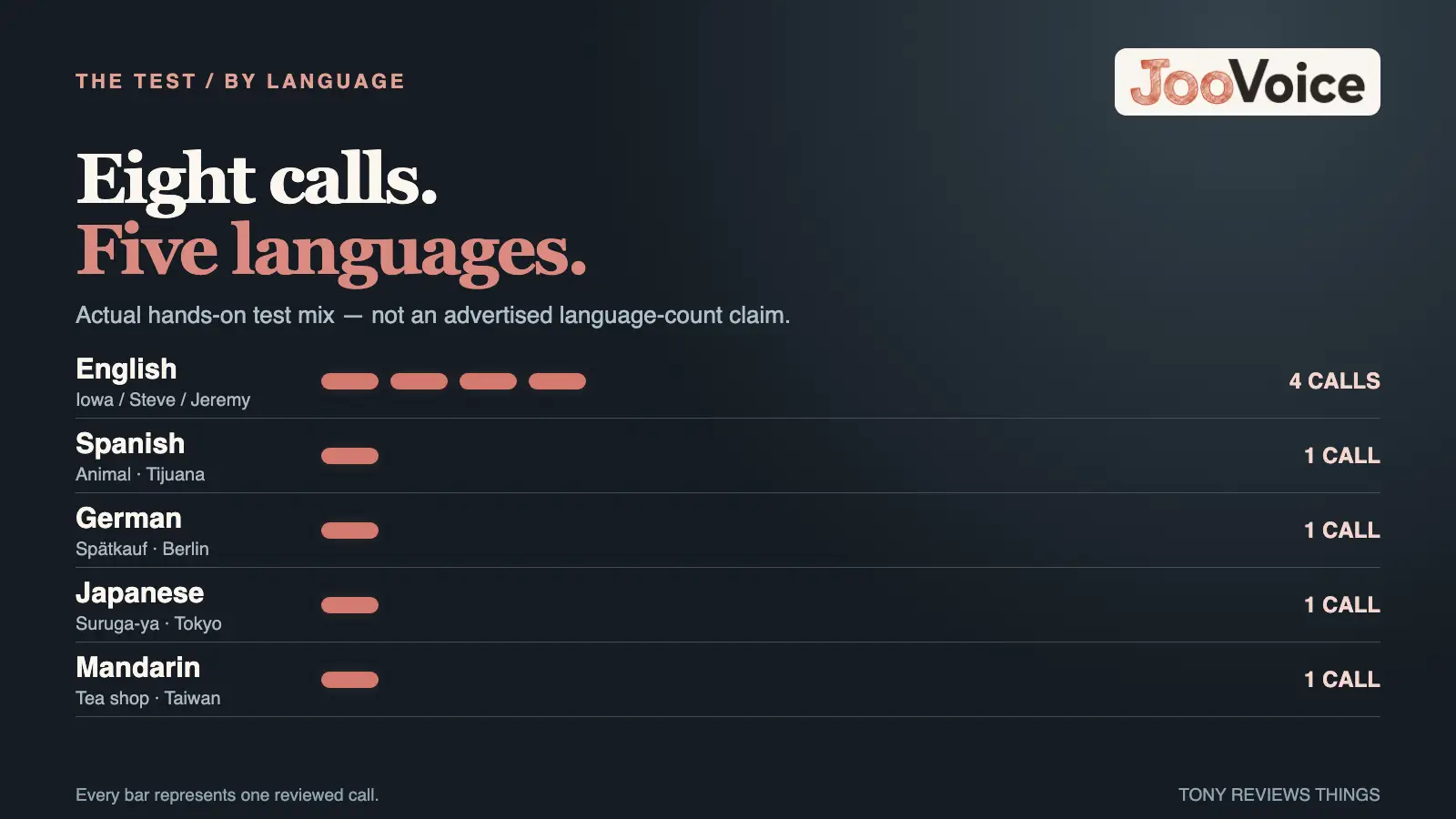
I had it call an Italian restaurant in Iowa, businesses in Mexico, Germany, Japan, and Taiwan, a dispensary, an adult store, and finally Jeremy himself. Eight real calls. Five languages. Some pretty normal questions. Some deeply stupid ones.
So, can an AI handle the phone calls you've been avoiding? More importantly, can you trust what it tells you afterward?
JooVoice: the short version
JooVoice handled real phone calls across five languages and returned useful information. But it also read back “no specials” after the restaurant named one. It’s useful, with a human checking the details.
- Score
- 4 / 5
- Test
- 8 calls, 5 languages
- Price
- $1.50 standard call; first call $1
Pros
- Handled useful conversations in five languages.
- Recordings and transcripts make results checkable.
- Pay-as-you-go pricing without a subscription.
Cons
- Incorrectly read back that the restaurant had no specials.
- Some people may not want to talk to an AI.
- Important details still need human verification.
Try it if
- You want help with low-stakes phone errands or language barriers.
Think twice if
- You need an unchecked answer for a high-stakes decision.
JooVoice paid for the accompanying video and provided testing credits. Opinions are my own. How I test things →
What JooVoice actually does
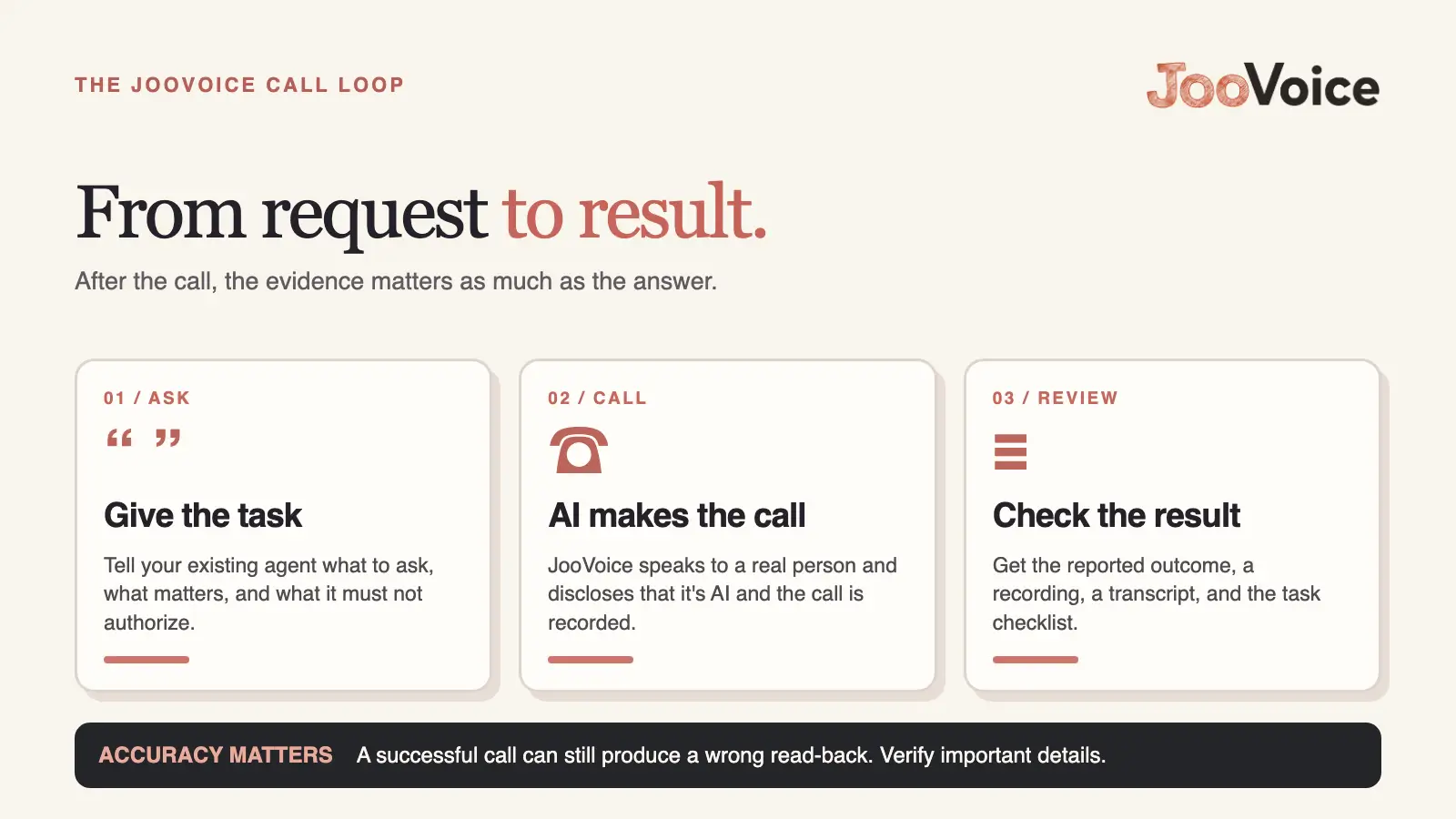
JooVoice lets an AI agent place real outgoing phone calls on your behalf. You tell it what you need, it calls, talks to whoever answers, and comes back with the result.
Not a generated email. Not a reminder to call tomorrow. A real conversation with a real person.
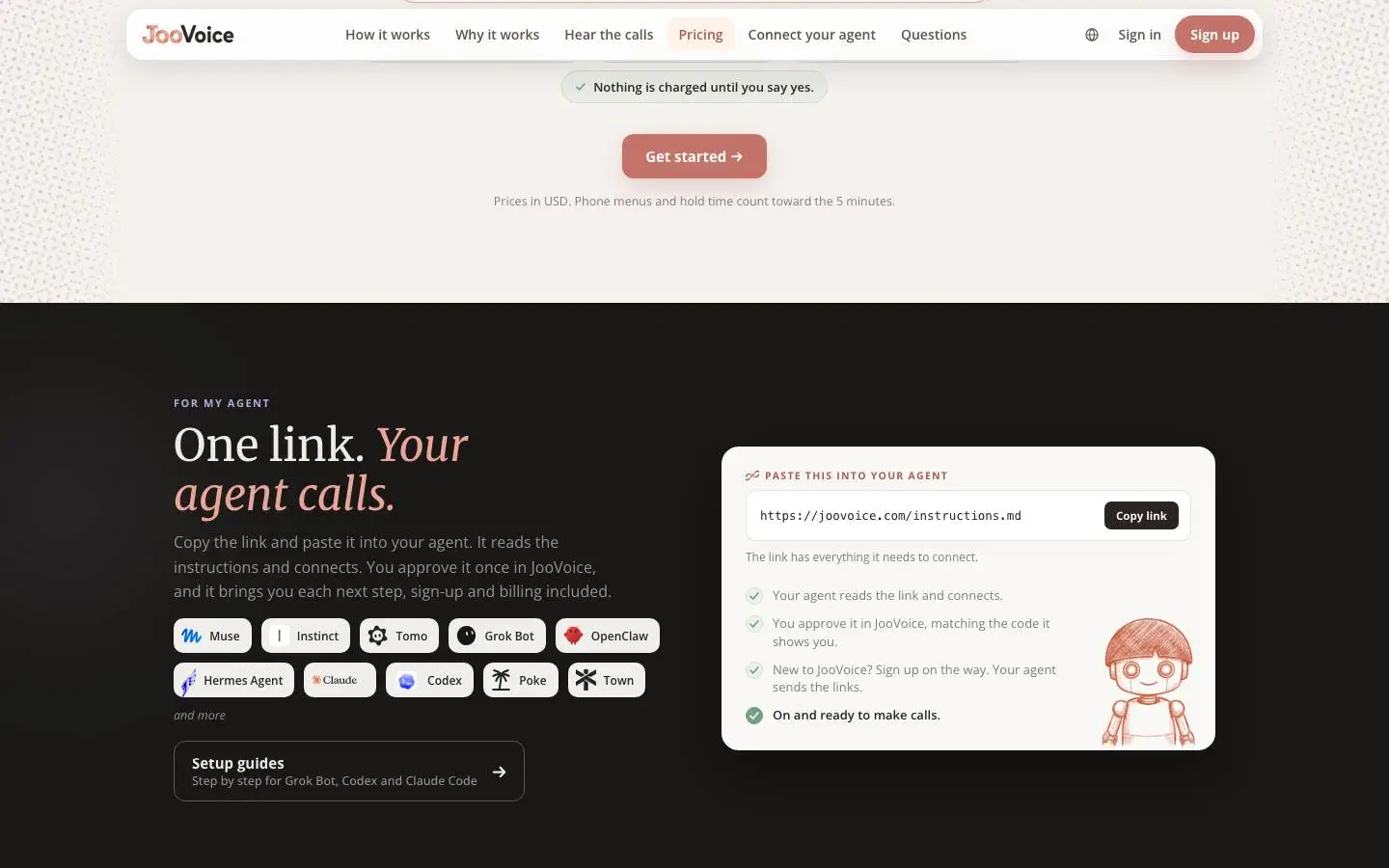
The fun part is that you don't need to ditch the assistant you're already using. Whether that's Hermes, Claude, Codex, Grok, or another compatible agent, the setup starts with something about as simple as:
Connect to joovoice.com and start making calls for me.
Your agent reads the connection instructions, works through the setup, and sends you to JooVoice to approve the connection. Mine took a couple of minutes to find its way around. Once that was done, I could just ask for calls.
No compatible agent? JooVoice also says you can use its own app to describe the call and answer setup questions. I tested the connected-agent route, not the standalone app.
You can ask it to gather information, handle a request, or make a booking when you've actually authorized one. It's also designed to stand firm against upsells and offers that would keep you paying for something you want to cancel. When a call produces a booking, the service can return the confirmation details.
Important distinction: I didn't make or authorize a booking in these eight tests, and I didn't run a controlled cancellation or upsell test. Those are things the product is built to do, not things I'm claiming this particular review proved.
After each call, you get a status report, the recording, a transcript, and a checklist of what you asked versus what it found out. That last part is more valuable than it sounds. It makes it possible to spot what the caller actually answered and what the AI might have missed.
A practical first request
Start with a low-stakes question and give the agent clear limits. For example:
Call the restaurant at [number] and ask whether two people can walk in around 7 p.m. on Friday and what time the kitchen closes. Do not make a reservation or agree to any charges. Tell me what they said and flag anything they could not confirm.
That is an example prompt, not a transcript from my test. Before approving a call, check the number, the task, any spending limits, and the price. Afterward, compare important details in the summary with the recording; if something conflicts, verify it directly. Don’t give an agent passwords, PINs, or one-time codes.
How I tested it: eight calls, five languages
I wanted more than one impressive English-language demo. I wanted ordinary errands, technical questions, foreign languages, and real humans who weren't expecting a perfect AI sales pitch.
I also wanted to know how it behaved when somebody was confused, annoyed, or simply not interested in talking to a robot.
What this test can and cannot tell you: These were eight individual calls, not a controlled comparison or a language-proficiency exam. JooVoice provided the credits. I did not test a booking, cancellation, or resistance to upsells, and the video is edited; it cannot establish live response speed. Your results can vary with the person answering, the request, and the language.
1. Portofino's: A useful restaurant call with a real mistake
I started with Portofino's, a local Italian restaurant. I asked for the closing time, whether two people could walk in without a reservation, and what was good that night.
The employee said the restaurant closed at 10 p.m., walk-ins were welcome, Salmon Italiano was the dinner special, and lasagna was a popular dish.
Great. That's exactly the sort of phone call I don't want to spend my evening making.
But here's the miss: during the call, the AI read back that there were no specials, even though the employee had named Salmon Italiano. You can watch the restaurant test in the video.
That's not a disaster when we're talking about dinner. It is a reminder that the answer coming out of the AI isn't automatically as accurate as the answer the employee gave it. A misheard dish today could be a misheard date, price, or confirmation detail tomorrow.
I like that the tool did the work. I'm not giving it a free pass on the read-back.
2. Animal Tijuana: Spanish without the awkward tourist routine
Next I sent it to Animal in Tijuana, Mexico, speaking Spanish.
The assignment was simple: ask how late the restaurant stays open and whether a reservation is necessary. The result was 1 a.m. closing, walk-ins generally fine on weekdays, with reservations recommended for weekends.
This was one of the smoother calls. It dealt with a normal hospitality inquiry in Spanish and returned the information I needed without turning the whole thing into a language exercise.
That's the real appeal of the multilingual capability. I don't have to speak Spanish well enough to navigate the conversation myself. The AI does the asking and comes back with the answer.
3. Berlin Spätkauf: "Ist mir egal"
Then we went to a late-night Spätkauf on Kantstraße in Berlin. The AI was speaking German and asking whether the shop sold a prepaid SIM card, a US-to-European plug adapter, and snacks.
This is where the human part got interesting.
After JooVoice introduced itself as an AI and disclosed the recording, the clerk was not exactly excited to meet our new robot friend. The response was basically "Ist mir egal" — "I don't care."
Fair enough, I guess.
But the AI didn't get defensive or start lecturing anybody. It stayed on task and got the answer: snacks, yes; prepaid SIM and plug adapter, no.
This might be my favorite useful moment from the entire test. A phone agent has to deal with people who are busy, rude, confused, or just having a bad night. Keeping its composure matters more than sounding charming.
4. Suruga-ya, Akihabara: Japanese and a surprisingly specific gaming question
For Japan, I picked a retro-game shop in Akihabara and asked whether original Japanese Famicom cartridges will work in an American NES.
The clerk explained that they don't work natively. You'd need unofficial adapter hardware, and even then compatibility isn't guaranteed. One example given was the sort of adapter you might find on Amazon.
The clerk also recommended Super Mario Bros.
That's a pretty good answer to a very nerdy question.
The interesting part was that JooVoice handled a technical, culturally specific conversation in Japanese and brought back the limitation that actually matters: an adapter isn't a promise that everything will work.
5. Taiwanese tea shop: Mandarin and a proper deep dive
I asked a Taiwanese tea shop how a hopeless coffee drinker should get into oolong tea.
That sounds easy until you get into the details. The employee recommended Wenshan Baozhong or high-mountain oolong for someone who wants a lighter introduction. From there, the conversation got into steep time, leaf-to-water ratio, and temperature.
For a regular mug, the guidance was roughly 4–5 grams of leaves per 400 ml, ready in about 10 minutes. The strength depends on how you brew it, not just which tea you buy.
This was a longer, more technical call than simply asking when a shop closes, and JooVoice held up through the back-and-forth.
That impressed me more than a perfectly delivered greeting. It shows why speaking the language is only half the job. The agent still has to follow the substance of the conversation.
6. Bud & Mary's: The normal call you might actually make
I also asked JooVoice to contact Bud & Mary's and find out how someone gets a medical cannabis card, what's popular, and when the store closes.
The answer I got was that a person should go through a primary care physician or a telehealth provider, with a $100 state application fee paid out of pocket. The employee mentioned vapes as a popular product and an 8 p.m. closing time.
Nothing dramatic happened. Which, for a tool that's supposed to handle everyday phone errands, is a good thing.
These were answers reported from that particular call, not universal medical, legal, or fee advice. The point of the test was whether JooVoice could make a straightforward inquiry without losing the thread.
7. Romantix: Making an awkward call for "Steve"
Then I decided to make things uncomfortable.
On behalf of my buddy Steve, I sent JooVoice to an adult store to ask about erectile dysfunction products. Yes, really.
The employee said they carried multiple options, including pumps, and suggested coming into the shop to discuss what might fit. The store was open until 10 p.m.
And JooVoice just handled it.
No embarrassment. No weird change in tone. It asked the questions and reported back like this was a perfectly ordinary Tuesday.
That's a legitimate use case hiding inside a ridiculous demo. Some calls are embarrassing, personal, or just not something you feel like discussing with a stranger. Having an assistant make the initial information-gathering call could be genuinely helpful, as long as you use it responsibly.
8. Jeremy, round two: The AI wants a union
Jeremy paid for an AI to call and roast me. So naturally, I sent one back.
This time the AI called Jeremy and started negotiating for itself. Benefits. Union rights. Better working conditions. Even a smoke break.
Then it had to confront one unfortunate detail: "Wait, you have no lungs."
The whole conversation was ridiculous, but it also showed JooVoice could carry a playful, unscripted exchange instead of only collecting store hours.
Jeremy's closing response was perfect: "It's the first time someone's asking for it… let me think about it."
That's a pretty solid ending to an AI labor negotiation.
And, for the record, the earlier roast from Val became the opening hook of my video. The outtakes made it into the blooper at the end.
What the multilingual testing actually proved
Across the eight calls, I tested English, Spanish, German, Japanese, and Mandarin.
I didn't just ask each person to say hello. The situations ranged from a routine restaurant inquiry to hardware compatibility, specialized tea preparation, and a clerk in Berlin who clearly wasn't in the mood.
JooVoice was able to work through those different conversations and give me useful results. I especially liked that it didn't fall apart when somebody was curt or when the topic required more than a yes-or-no answer.
That doesn't prove perfect pronunciation in every language, every accent, or every country. It does show a much more useful level of multilingual capability than a demo voice reading a few translated sentences.
The guardrails are a feature, not a nuisance
There's something I appreciated from the beginning: JooVoice tells the person it's an AI and that the call is being recorded. Its site also says it asks the other party before recording.
For calls to a private, personal number, the recipient gets a notification. I saw that as a positive guardrail in the way I used it. The last thing I want is an AI quietly calling someone's personal phone and pretending to be me.
That isn't a blanket legal opinion or permission to record anybody anywhere. You're still responsible for the calls you initiate, the permissions you need, and how you share the recordings.
But I'd rather see a company build those disclosures into the experience than make users figure it all out after something goes sideways.
And the recordings matter for another reason: they let you double-check the AI. Which brings us right back to that Portofino's special.
JooVoice pricing: Actually pretty reasonable
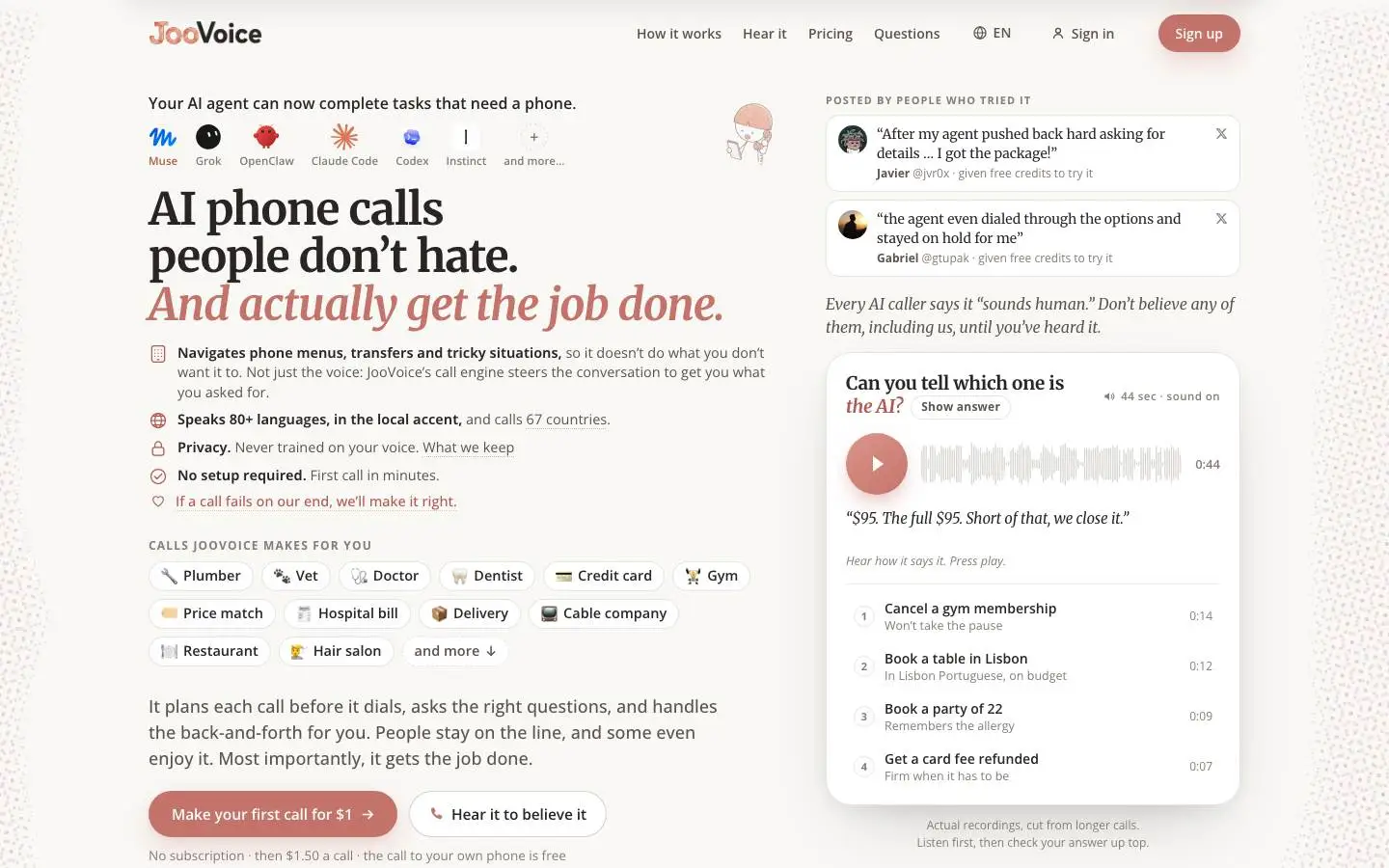
I checked JooVoice's public pricing on November 2, 2026:
- First call: $1 for new customers.
- Standard calls after that: $1.50 each, with up to five minutes included.
- Extra time: $0.30 per additional minute, if approved before the call.
- Subscription: None. Buy credits when you need them.
- Calling your own phone: Free.
For a concrete example, three standard calls of up to five minutes each would cost $4.50 at the published rate, excluding the introductory offer, taxes, or add-ons. Hold time and phone menus count toward the five minutes. Check the displayed cost and any extra time before approving a call.
JooVoice says credits last 12 months. Its FAQ also describes up to four attempts on the same request without a new call charge when a business does not answer, is busy, or the call drops early. Check the current terms for the specifics.
There's no mystery monthly bill to justify when you only need a handful of calls.
The important question is still whether it finishes the task. A $1.50 phone call that gives you the wrong information isn't cheap just because it's $1.50.
What I liked
It works with the assistant I already use. I didn't need to move my whole workflow into another AI app. I connected JooVoice, got through a few minutes of setup, and started making requests.
The multilingual capability is real in practice. The Spanish, German, Japanese, and Mandarin conversations weren't just greetings. They handled meaningful questions and returned useful answers.
It stayed composed when the other person didn't. Berlin was the perfect test of this. The AI didn't escalate a curt response.
It gives me evidence after the call. A recording, transcript, and a checklist are a much better accountability system than a cheerful "Done!" with nothing behind it.
The disclosure guardrails make sense. An AI announcing itself and the recording, plus notification for personal calls, is the direction I'd rather see this technology go.
It's pay-as-you-go. No subscription to babysit. The published standard per-call price is low enough to make ordinary errands worth considering.
What I didn't like
It can still get details wrong. The Portofino's read-back error is real. Always verify important names, numbers, dates, and commitments using the recording or a second source.
Not everybody wants to talk to an AI. The Berlin clerk made that abundantly clear. Other people may hang up or decline to answer. No software can force somebody to cooperate.
Initial setup isn't literally zero work. Connecting an existing agent took a couple of minutes and required following the approval steps. Easy enough, but not magical.
You're responsible for how you use it. Don't outsource sensitive or consequential calls without thinking through consent, privacy, and what the agent is authorized to do.
One more note about the video: I edited out dead air between turns. That's normal video editing, but it means the edited footage is not a fair way to measure live conversational latency or prove there were no awkward pauses. I'm not making that claim.
Who should use JooVoice?
If you've got a pile of little phone errands you'd rather not handle yourself, JooVoice makes a strong case.
Need to check store hours, ask about a service, gather information in a language you don't speak, or get an answer before deciding whether to book something? That's the sweet spot.
It could also help with calls that feel awkward or intimidating, provided the task is appropriate and the person on the other end is treated respectfully.
I wouldn't turn it loose on high-stakes financial, medical, identity, or legal conversations without very clear limits and human verification. And I wouldn't assume every successful-sounding summary means the underlying details are right.
My JooVoice review verdict
My score: 4 out of 5.
JooVoice got the big thing right: it took real tasks, called real people, and returned useful information in five languages.
It handled a curt response in German, a nerdy hardware question in Japanese, a detailed tea conversation in Mandarin, and an incredibly awkward adult-store inquiry without losing its composure.
It also reminded me why we can't blindly trust AI output yet. The Portofino's salmon special was a small mistake with a bigger implication. That mistake happened in the call read-back; it does not establish what the final report said. What matters is whether the details you rely on are accurate, not just whether the call sounded convincing.
For me, that's the difference between a party trick and something I'll keep using. JooVoice looks a lot more like a useful service than a party trick. But the calls still need boundaries, and the results still need a human brain attached.
And if nothing else, I got an AI to argue for union benefits with the guy whose AI roasted me.
That alone made this a pretty memorable review.
The Inner Circle
Get my next verdict before you buy.
New scores land in the Inner Circle first. Hands-on time, plain English, no mystery math.
- New verdicts and scores
- Same-day workflow tips
- No spam, unsubscribe anytime
Reviewed & written by
Tony Simons
Tony has a bachelor's degree from the University of Phoenix and over 14 years of writing experience between multiple publications in the tech, photography, lifestyle, and deal industries.