It started with a notification that every digital citizen dreads. I opened Threads to check the morning news, and was greeted by a full-screen alert: “We detected unusual activity on your account.”
Standard security theater, I thought. I played along. The app demanded I solve a captcha. I did. It asked for an SMS verification code. I sent it. Finally, it required a video selfie to prove I wasn’t a bot. I held my phone up, turned my head to the left, turned my head to the right, and uploaded the biometric proof that I am a living, breathing human being.
The result? Banned anyway.
My account was gone. The reason? “Account Integrity.” Apparently, Meta’s automated systems decided I was a fake account, ignoring the video evidence I had just submitted. There was no specific post cited, no warning strike, just a digital eviction notice claiming my identity was a fabrication.
I wasn’t the only one, either. A quick search for “Threads account suspended” on my personal feed revealed a timeline littered with similar stories from just the last few hours. It looks like a fresh ban wave hit the platform today, sweeping up legitimate users alongside whatever bot nets the AI was actually hunting. Reddit and X are currently filling up with confused refugees asking the same question: “Why me?”
View on Threads
Here is the irony. I am not an Instagram power user. Honestly, I only keep that app installed because Meta mandates it as a digital passport to access Threads. But on Threads, I have been putting in the work. I have had the account for over a year, but in the last six weeks, I really dialed in. I posted consistently. I engaged with the community, replied to comments, and actually used the platform as intended. I watched my follower count climb from 74 to over 600.
I was finally getting traction. And that is exactly what killed me.
To a mindless moderation algorithm, legitimate organic growth looks suspicious. My success was flagged as spam. The system saw a user suddenly gaining influence and decided it must be fake. It’s a flaw in the pattern-matching logic: the behavior of a dedicated new creator is mathematically indistinguishable from a bot farm warming up an account. In the court of AI moderation, there is no presumption of innocence—only false positives and collateral damage.
What followed was a masterclass in modern tech dystopia. I appealed immediately. Instagram, to its credit, realized the mistake and reinstated me almost instantly. My “fake” identity was verified as real within minutes on the parent app.
But Threads? Threads didn’t get the memo.
The Algorithmic Purgatory: Why Appeals Fail
Despite sharing the same Accounts Center, the same login credentials, and the same backend infrastructure, my Threads account remained in digital purgatory.
The appeal button was grayed out because I had technically already appealed via Instagram. The system thought the case was closed, yet the ban remained active on the secondary app. The “Help Center” was a labyrinth of FAQ pages that looped back on themselves, offering generic advice on how to recover a Threads account while ignoring the synchronization error I was actually facing. I was locked out, and there was no one to call.
That is when I realized the grim reality of Meta’s new support tier. If I wanted my account back, I was going to have to pay for it.
The $15 Customer Service Fee
We used to joke that if you aren’t paying for the product, you are the product. In 2026, the equation has changed. You are still the product, but now you have to pay rent just to stay on the shelf.
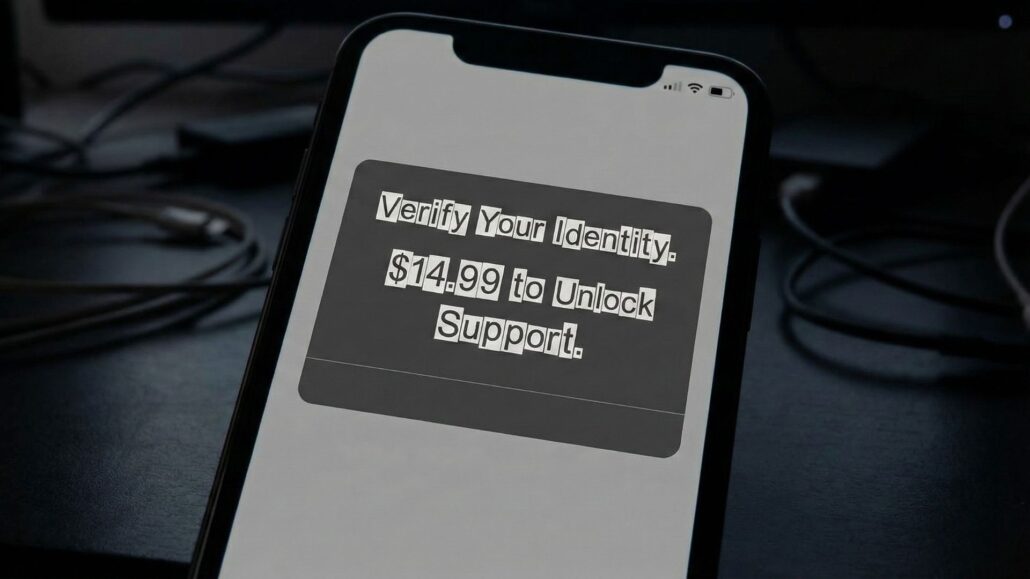
I subscribed to Meta Verified on Instagram. Not because I wanted the blue checkmark. Not because I wanted “exclusive stickers,” better reach, or artificial clout. I paid $14.99 because it is the only way to unlock a “Contact Support” button that actually connects you to a human being.
Think about that for a second. Meta, a company worth trillions, has effectively paywalled its customer service.
If you are a free user and the algorithm falsely flags you, you are screaming into the void. Your digital legacy is at the mercy of a bot that doesn’t understand context or nuance. But if you pay the toll, you get to skip the line. You get the privilege of pleading your case to a person who has the power to override the machine.
This is a protection racket. “Nice account you have there. Shame if an algorithm deleted it. For fifteen bucks a month, we might actually listen when you tell us it was a mistake.”
Verification Theatre
The process itself is humiliating. I handed over my credit card. I uploaded photos of my government ID, turning over my most sensitive data just to prove I exist. And then? I waited.
“This could take up to 48 hours,” the app warned me.
I am sitting here, wallet lighter, staring at a processing screen, waiting for permission to use the platform I help populate with content. I am not trying to run a scam. I am not a bot farm. I am a guy who had a good month on social media, and the automated sheriff shot me for it. The delay feels punitive, a final reminder that even when you pay, you are still just a user record in a database, waiting for an admin to toggle a switch.
The Dangerous Precedent
This isn’t just about my account. It is about the two-tier system we are accepting.
We are moving toward a web where “Identity” is a luxury good. The blue checkmark used to mean you were notable—a public figure, a journalist, or a brand. Now, it just means you have a customer support ticket. It creates a perverse incentive for Meta. Why invest in better moderation AI or free support staff when you can frustrate users into subscribing?
If the “free” experience becomes too risky to rely on, serious users will feel forced to pay for safety. Every false positive is a potential new subscriber. Every algorithmic error is a sales pitch for Meta Verified.
I am still waiting for my checkmark. I am still waiting for my Threads account. But one thing is verified already: the system is broken, and we are paying to fix it.
Expect a full review of this bullshit, once it all plays out.