
“AI Can’t Be Creative” Is a Comfort Blanket, So Stop Saying It
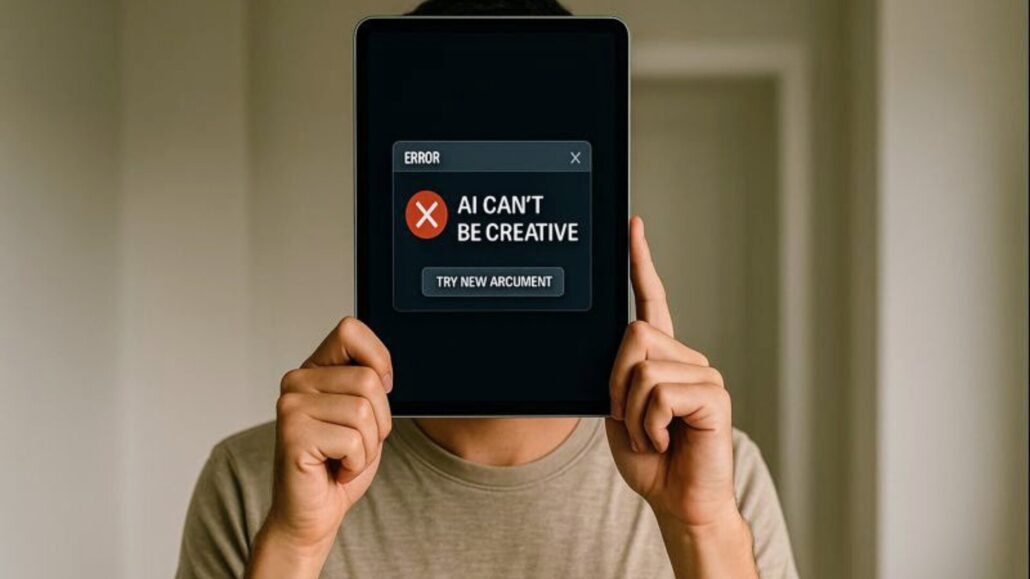
There’s a phrase I keep seeing, usually typed with the confidence of someone slamming a courtroom gavel:
“AI can’t be creative.”
It sounds decisive. It sounds moral. It sounds like the argument is over and we can all go back to pretending the future isn’t arriving like a freight train with Wi-Fi.
But it’s also doing something else.
It’s giving people emotional cover.
Because if AI “can’t be creative,” then your identity as a creative person is safe. Your work is safe. Your value is safe. The gate stays where it is, the rules don’t change, and nobody has to re-learn anything. You get to keep believing that creativity is a magical substance you’re born with, and not a skill you sharpen.
That’s the comfort blanket.
The problem is, it’s a blanket woven out of a shaky definition of creativity.
Creativity is not a soul. It’s decisions.
View on Threads
We love romanticizing creativity. We talk about “the spark,” “the muse,” “the gift.” Like a lightning bolt hits your skull and out comes a perfect idea, fully formed, ready for print.
That’s a great story. It’s also not how most creative work gets made.
In real life, creativity looks like this:
- Making choices under constraints
- Combining influences without copying
- Refining something ugly into something usable
- Knowing what to cut
- Taking feedback without folding like a cheap lawn chair
- Shipping anyway
It’s taste plus iteration, with a side of courage.
If that definition makes you uncomfortable, good. It means we’re getting closer to the truth: creativity is not a mystical force field. It’s a process. It’s work.
Now, here’s where people get mad. If creativity is a process, then yes, AI can participate in parts of it.
Not all of it. Not the most important parts. But parts.
That does not mean AI is “alive.” It means the “AI can’t be creative” crowd is arguing the wrong thing.
What AI actually does, and what it doesn’t
AI is great at a specific kind of output: plausible, patterned, and fast.
That’s not an insult. That’s the tool.
Give it a prompt and it can generate:
- 20 headline variations
- a rough outline
- a first draft
- a list of angles you didn’t think of
- a rewrite that cleans up your messy paragraph
- a summary of your own notes
- a dozen metaphors you can steal and improve
That’s useful. It’s also not the finish line.
Because AI is also wildly consistent at:
- being generic when you’re vague
- sounding smart when it’s wrong
- giving you “safe” ideas that feel familiar
- producing confident filler when it doesn’t know
AI can generate a draft. It cannot automatically generate judgment.
And judgment is where creativity lives.
The person who wins in an AI-heavy world isn’t the person who can press “Generate.” It’s the person who can look at the output and say:
- “This is boring.”
- “This is derivative.”
- “This is missing the point.”
- “This needs tension.”
- “This needs proof.”
- “This needs a human spine.”
AI can hand you clay. It can’t tell you what sculpture matters.
The dirty secret: a lot of “human creativity” is just remixing anyway
Here’s the part nobody wants to admit out loud:
A lot of creative work is remixing patterns that already exist.
Music borrows chord progressions. Design borrows layout rules. Writing borrows structures. Film borrows shots. Even “original” ideas usually show up wearing a trench coat full of influences.
Creativity isn’t “no influence.” Creativity is transforming influence into something with intent.
That’s why the “AI is just remixing” argument doesn’t land like people think it does. Humans remix too. The difference is that humans can attach meaning, context, and responsibility.
If you want to attack AI, attack the real weakness: it does not understand consequences. It does not care about truth. It does not know what it’s like to be embarrassed. It does not have skin in the game.
But saying “AI can’t be creative” is like saying “a camera can’t be art.” Correct in a narrow, philosophical sense, and completely useless in the real world.
Cameras changed art anyway. Photoshop changed art anyway. Sampling changed music anyway.
The tool always shows up. The people who adapt become annoying legends. The people who don’t write thinkpieces about how the tool is cheating.
“But AI doesn’t have lived experience”
Correct. That’s why the human still matters.
This is the strongest counterpoint, and it’s real.
AI doesn’t have lived experience. It doesn’t have heartbreak, bills, grief, joy, boredom, obsession, or the specific flavor of humiliation you feel when you re-read something you wrote last year.
AI can’t tell you what it felt like to hold a dying parent’s hand. It can’t tell you what it felt like to get laid off. It can’t tell you what it felt like to make something you’re proud of and have nobody notice.
That lived experience is not just “vibes.” It’s the raw material of meaning.
So if you want to defend human creativity, defend the part that can’t be automated: point of view.
Your creative edge is not that you can type words. It’s that you can say, “Here’s what I believe, here’s why, here’s what I tested, here’s what I saw, here’s what I’m willing to stand behind.”
AI cannot take responsibility for what it says.
You can.
That’s the whole game.
The real problem isn’t AI creativity. It’s human laziness with AI output.
Most people who complain that “AI isn’t creative” aren’t actually reacting to the best use of AI.
They’re reacting to the worst use:
Low-effort, copy-paste content that feels like it was assembled by a polite toaster.
And yeah, that stuff sucks.
But that’s not an AI problem. That’s a standards problem.
If someone uses AI to generate a blog post and they don’t:
- add proof
- add opinion
- add experience
- add edits
- add accountability
then the content is bad because the creator didn’t do the job.
AI didn’t force them to publish slop. It just made slop cheaper.
And here’s the uncomfortable part: slop was already everywhere. AI is just accelerating the collapse of “average.”
Which is honestly great news if you’re willing to do real work.
So what does “creative with AI” actually look like?
Let’s make this concrete. Real creativity with AI looks like:
1) Constraints that sharpen, not blur
Instead of “write me an article about X,” you give it guardrails:
- audience
- tone
- what you refuse to say
- what you must prove
- what you must include
- what the reader should feel at the end
Constraints are where style is born.
2) Iteration with taste
AI gives you options. You choose, combine, and cut.
The creative act is the editing.
If your process is “Generate once, post immediately,” you’re not using AI creatively. You’re outsourcing.
3) Proof and specificity
The antidote to generic AI output is receipts:
- screenshots
- measurements
- personal testing
- step-by-step details
- examples that only you can provide
AI can help you organize those receipts. It cannot manufacture legitimacy.
4) A point of view that risks being wrong
The most “human” thing you can do is take a stance.
AI will try to keep you safe. It will hedge and soften everything unless you force it not to.
Creativity has teeth. If your piece doesn’t risk disagreement, it probably doesn’t matter.
The takeaway nobody wants, but everyone needs
Saying “AI can’t be creative” is comforting because it implies you don’t have to change.
But the truth is simpler and more annoying:
AI is a creativity amplifier. It amplifies the good and the bad.
If you have taste, standards, and a point of view, AI makes you faster and more prolific without hollowing you out.
If you don’t, AI makes you louder.
And the world does not need louder.
So don’t waste time arguing whether AI has a soul. That’s a philosophical detour people take when they don’t want to confront the real shift.
The real shift is this:
Creativity is becoming less about producing words or images, and more about making decisions, proving claims, and owning outcomes.
That is still human territory.
But it’s not automatic. You have to earn it.
“AI can’t be creative the way a hammer can’t be a house.”
Cool.
Now watch what people build with it.







Leave a Reply
Want to join the discussion?Feel free to contribute!