
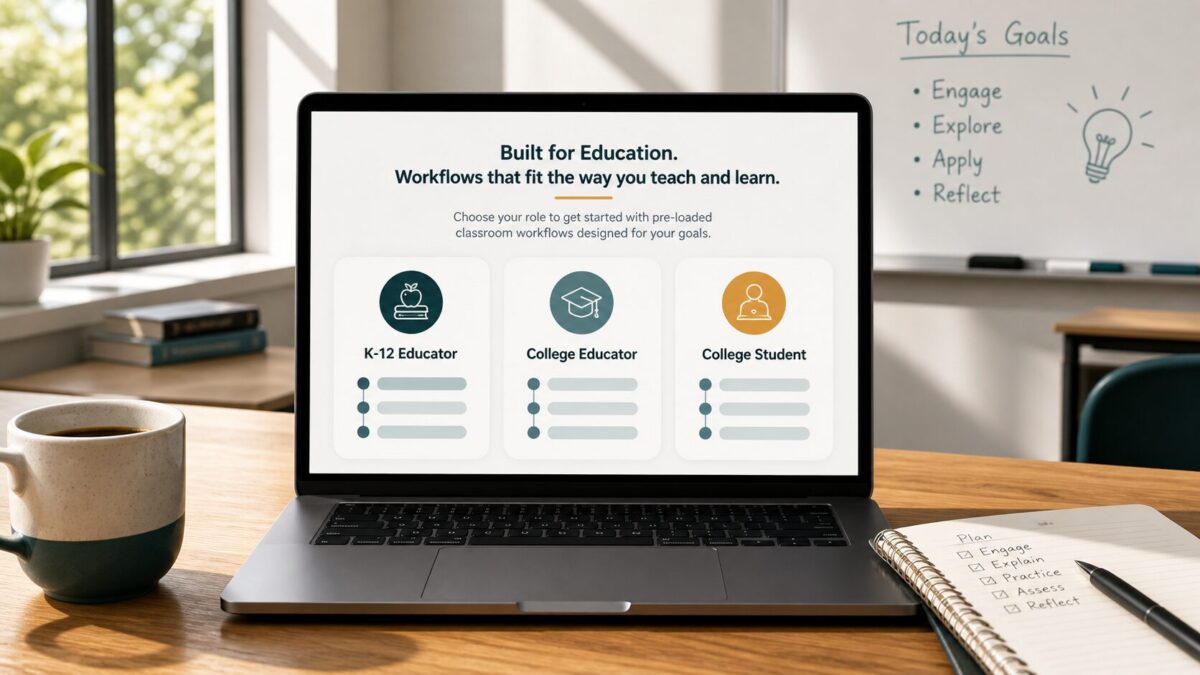
OpenAI education plugins are the company’s newest play for classrooms. They’re three role-specific workflow packages for ChatGPT Work and Codex. OpenAI announced them August 4, and the framing matters more than the feature list.
The bet is that schools don’t need another blank chatbot box. They need agents that arrive pre-loaded with the right skills, instructions, and workflows.
A plugin is a package of apps, role-specific skills, instructions, and common workflows. OpenAI’s description is a template for the whole agentic shift: less setup, more doing.
What OpenAI education plugins actually do
The three plugins split by role. K-12 Educator is for lesson planning and classroom materials. Think differentiated resources, interactive visuals, exit-ticket briefs, family updates, and translation workflows.
College Educator handles course design, syllabi, interactive websites and multimedia assessments, learner adaptation, LMS packaging, and calendars and documents.
College Student turns selected course materials into guided tutoring, practice activities, study guides, quizzes, flashcards, and interactive visual explanations.
Nothing in these OpenAI education plugins is a standalone feature drop. Each one assumes an institution that approves materials, calendars, documents, and connected apps. That’s the design line worth noticing.
The catch is who gets them
These aren’t available to ordinary ChatGPT users. The announcement says the plugins ship through ChatGPT Edu and ChatGPT for Teachers district deployments. Interested organizations have to contact OpenAI’s team.
ChatGPT Edu launched in 2024 and gives institutions managed workspaces with privacy, security, and administrative controls. ChatGPT for Teachers arrived in 2025 for verified U.S. K-12 educators and districts, with FERPA protections and a data privacy agreement.
The OpenAI education plugins sit on top of that infrastructure. That’s why administrators decide what gets connected.
There’s no public pricing. There are no named learning-management systems or third-party apps.
EdTech Innovation Hub’s coverage makes the same point: OpenAI lists no supported LMS and no performance results.
Institutions keep control over which tools and permissions are available. That’s the institutional pitch, and it’s also the reason you can’t just try these tonight.
What OpenAI says, and what it hasn’t shown
OpenAI says more than 200 million people aged 18 to 24 use ChatGPT weekly. It claims advanced student users leverage ChatGPT’s capabilities roughly 90 to 99 percent less than power users.
The company offers no definition of power user, no measurement method, no sample, and no period for that comparison. Independent coverage flags exactly that gap.
OpenAI also says students in ChatGPT Edu deployments develop more advanced usage patterns than free users. The company claims that holds across nearly every capability, with no sample sizes or numerical comparisons.
The Estonia numbers in the announcement, more than 20,000 students and 4,600 teachers, are OpenAI’s own figures. Don’t treat them as independently verified.
The stated reason for all this is closing what OpenAI calls a capability overhang among college-age users. Structured access, the company argues, helps students build deeper usage patterns. That’s the case for managed environments: less freedom, more guidance. The payoff is a claim that students get better at using AI because of it.
Forbes contributor Ray Ravaglia frames the launch as a move from answers to workflows. He also notes the early reactions OpenAI presents are company-collected, not independent outcome evidence.
What this actually means
I covered the ChatGPT Work guide when it landed, and ChatGPT Study Mode before that. Those were consumer-facing education features. These plugins are the institutional side of the same push.
OpenAI is building an education channel through districts and universities. The product is a managed agent environment where administrators decide what students and teachers can do. Compare that to a plain consumer chatbot and the difference is obvious.
The consumer race is about features. This is about distribution through institutions, and the OpenAI education plugins are the vehicle. The catch is that schools can’t evaluate them like a normal product. No pricing. No named LMS. No independent research on whether they improve learning.


