
Tech News
X to Open Source Recommendation Algorithm on January 17
 By Tony Simons 4 min read
Disclosure: We may earn a commission when you shop through the links below. It never changes the verdict. Details

Disclosure
We may earn a commission when you shop through the links below. Opinions stay independent. Full disclosure

If you have ever opened X, scrolled for a minute, and thought, “Why is my feed suddenly full of [insert niche obsession here]?” you are about to get some answers. Or at least the code that might explain them.
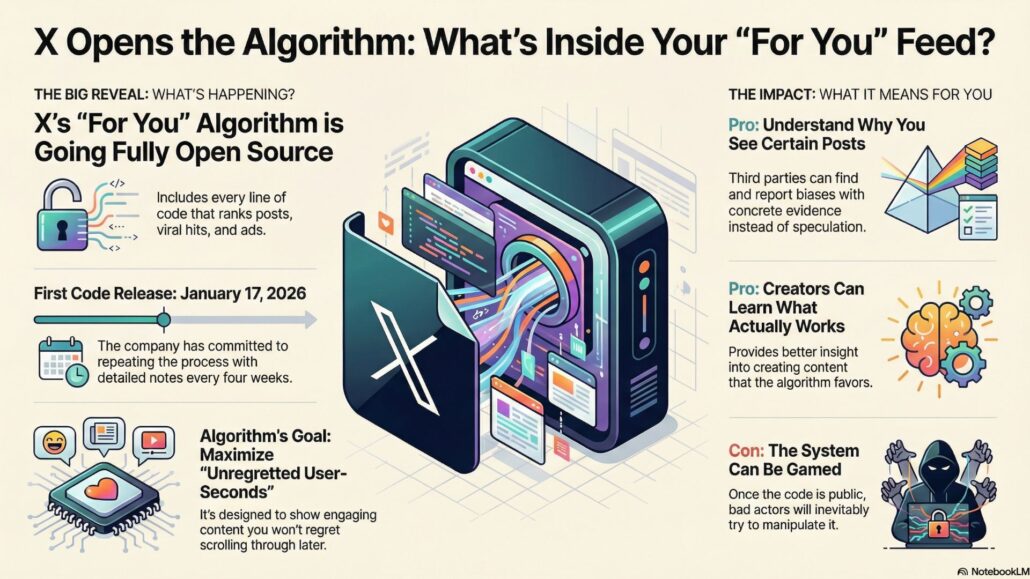
On Saturday, Elon Musk announced that in seven days (January 17, 2026), X will make its newly rebuilt recommendation algorithm fully open source. That includes every line of code that decides which posts show up in your “For You” timeline, from people you follow to random viral hits and ads. It is not a partial release like previous attempts. It is the real deal, and X says it will repeat the process every four weeks with detailed notes on what changed.
We will make the new 𝕏 algorithm, including all code used to determine what organic and advertising posts are recommended to users, open source in 7 days.
— Elon Musk (@elonmusk) January 10, 2026
This will be repeated every 4 weeks, with comprehensive developer notes, to help you understand what changed.
This comes after the xAI team (Musk’s AI outfit) essentially gutted and rebuilt the system from scratch. Musk has called it a massive undertaking running on thousands of GPUs, but the early signs suggest it is making people spend more time on the app. Whether that is a good thing is up to you.
So what actually powers your feed?
At its simplest, the algorithm is just a very complicated sorting machine. It looks at your likes, replies, time spent on posts, scrolls, and probably a dozen other signals to guess what you will want to see next. The new version is tuned to prioritize content that keeps you engaged without the post-scroll regret. Musk’s team calls it maximizing “unregretted user-seconds,” which is a fancy way of saying “stuff you won’t hate yourself for doomscrolling later.”
Past versions have been notoriously twitchy. One like on a geopolitics thread, and suddenly your feed is 80 percent international relations hot takes. The same goes for sports, crypto, or whatever rabbit hole you accidentally fell into. X has acknowledged the over-sensitivity problem and says the rebuild aims to smooth that out. We will see if the code backs that up.
Ads are getting the same treatment. They are ranked with roughly the same logic as organic posts, which could make them feel less intrusive (or more, depending on how aggressive the targeting gets).
Why now? And why bother open-sourcing it?
Musk has been promising transparency since he bought the company back in 2022. The first big code drop in 2023 was interesting but incomplete and quickly outdated. This time, the commitment is monthly updates, which sounds more serious.
Elon Musk shares his goal for the new Grok powered 𝕏 algorithm.
— DogeDesigner (@cb_doge) January 10, 2026
"It should be possible for somebody to post content as a new user with no followers and if that content is intrinsically excellent, it can be seen by a lot of people. That's our goal." pic.twitter.com/Vi8Bvi38CG
There is probably some regulatory pressure too. The European Commission has been poking around X’s algorithm for a while and just extended a data retention order through the end of 2026. Full disclosure might help with that. Or it might invite even more scrutiny once developers and researchers start digging.
For regular users, the practical upside is modest but real:
- You will finally know why certain posts keep appearing (or disappearing).
- Creators might get better at understanding what actually works.
- If there are biases (political, commercial, or otherwise), third parties can call them out with evidence instead of speculation.
The downside? Once the code is public, people will inevitably try to game it. X’s team will have to stay ahead of that.
What happens next
Keep an eye on X’s GitHub (or wherever they drop it) around the 17th. The release should come with those promised developer notes to explain the big changes. If history is any guide, the initial excitement will be huge, then the real work of auditing and critiquing begins.
For now, it is one of the more interesting transparency moves we have seen from a major social platform in years. Most companies treat their recommendation systems like trade secrets. X is betting that showing the cards over and over will build more trust than secrecy ever could.
I’ll will be watching closely when the code lands. If it actually helps explain why your timeline feels the way it does, that alone would be worth the wait.
What do you think? Game-changer or just another Musk promise? Hit the comments.
Tony Reviews Things cuts through the BS on apps, gadgets, and the platforms that shape how we use them. Follow @TonyRevsThings on X for more.
Reviewed & written by
Tony Simons
Tony has a bachelor's degree from the University of Phoenix and over 14 years of writing experience between multiple publications in the tech, photography, lifestyle, and deal industries.