

Australia’s chart authority just drew a hard line on AI music charts. The Australian Recording Industry Association (ARIA) confirmed on August 25, 2026 that wholly AI-generated tracks will no longer be eligible for the ARIA Charts.
The rule takes effect for the chart dated Monday, August 31, 2026, which ARIA publishes on Friday, August 28. This is one of the first times a major national chart has put a formal eligibility bar on generative AI rather than just issuing guidance.
Most charts have ducked this question. ARIA just answered it.
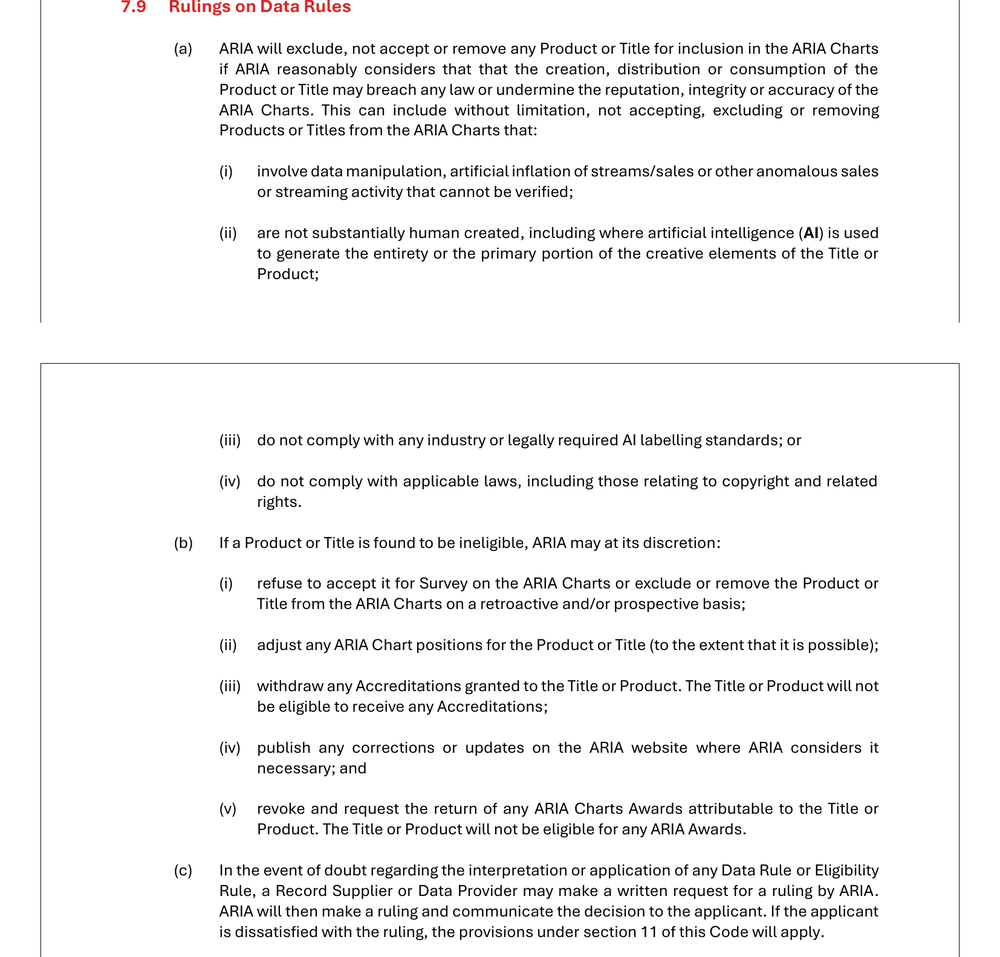
The decision follows global principles on AI recordings set out by IFPI, the international music trade group. Under the updated ARIA Charts Code of Practice, a recording built with generative AI is eligible only if it is substantially human made and raises no stream or chart manipulation concerns.
That sounds narrow. The signal isn’t. ARIA is treating AI as a labelling and eligibility problem for the industry, not just another studio tool.
Tracks that lean on AI in a supporting role, like a producer pulling ideas or edits from a model, stay eligible. The target is music made wholesale by services trained on artists’ recordings, the kind of thing that shouldn’t sit on a chart meant to measure what Australia actually listens to.
Why AI music charts just changed in Australia
I wrote about AI music hitting the charts earlier this month, and the Australian move is the kind of formal response that story was building toward.
ARIA CEO Annabelle Herd said the change reflects a wish to keep room for artists who use AI tools while making clear that music generated wholesale by services built on artists’ recordings is a different matter.
ARIA also strengthened its disputes process so artists and their teams can contest an exclusion and supply evidence of a recording’s eligibility. The trigger was practical, not theoretical. An AI-produced song reached number four on two separate Australian charts in July 2026, according to reporting ARIA itself referenced.
Here’s the catch that makes this interesting. ARIA admits it can only detect AI usage if you tell them, so the new rule leans on labelling and disclosure as much as detection. That’s the familiar shape of AI policy: the standard arrives before the enforcement tech does, and disclosure is the only tool that scales today.
What the AI music charts rule means for you
This reaches well past Australia. ARIA is calling on radio and other outlets that decide what gets played and promoted to implement similar changes, and it worked with IFPI plus other international bodies to line the rule up with global principles.
When one of the world’s more closely watched national charts sets a precedent, other markets borrow the language. Chart bodies in Canada and Japan have been watching the same debate, and ARIA’s wording gives them a ready template to adapt.
For listeners, the AI music charts change is mostly invisible day to day. Human-made and AI-assisted records stay on the chart exactly as before. The shift is about what can be manufactured and pushed onto a chart that doubles as a cultural scoreboard.
If you only skim the Monday chart, nothing looks different. If you make the music, it’s the difference between a quiet entry and a dispute you win with paperwork.
The EU AI Act labelling wave shows the same instinct across the Atlantic. The instinct is to make the machine-generated stuff identifiable before it floods the mainstream. For artists and platforms, the practical takeaway is disclosure.
If you release music in Australia, treat “substantially human made” as the rule to work to, keep documentation that shows where humans did the work, and expect radio and streaming promo to follow the chart’s lead. The cost of getting it wrong is not just a missing chart entry.
ARIA can decline, exclude, or remove a recording from the Charts, adjust positions, withdraw accreditations, and even revoke an ARIA number one Award if it determines a recording is ineligible.
Those sanctions apply to both the chart Survey and the annual ARIA Awards.
ARIA says it will keep the Code under review as AI policy and technology develop, which signals this AI music charts rule is a first version rather than a finished settlement. The line between AI-assisted and AI-generated will keep blurring as tools improve, and the “substantially human made” test will get harder to apply in practice.
I tracked the copyright fights already shaping AI music, and the Australian eligibility bar shows the industry moving from lawsuits toward structural rules.
The rule does not touch streams, sales, or where a song can be heard. It only governs a weekly chart that doubles as a cultural scoreboard. That narrow scope is what makes it durable where broader AI bans have stalled.
Expect more national charts to follow before the year is out, and expect the “how human is human enough” debate to dominate music industry conferences from here.


